


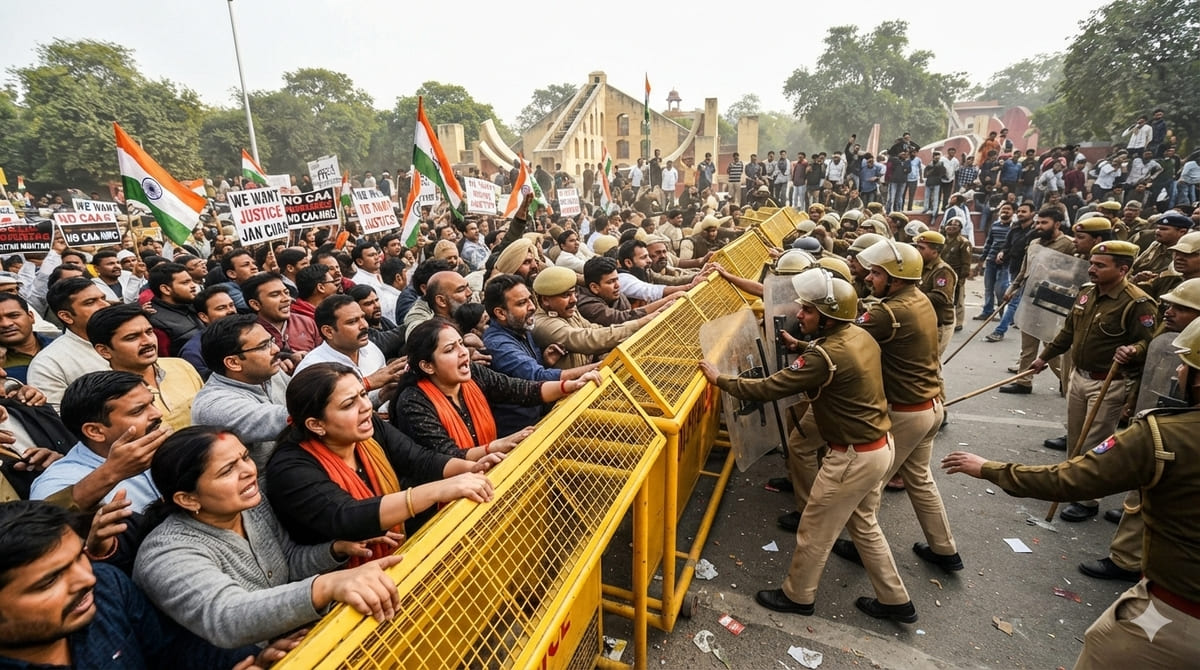
Demonstrations Intensify Against Chief Election Commissioner Gyanesh Kumar Over Claims of Electoral Manipulation and Internal Poll Body Discord
Political parties and student groups mounted coordinated actions at Jantar Mantar and in several states on Friday calling for the arrest and removal of Chief Election Commissioner Gyanesh Kumar. The actions stem from Rahul Gandhi’s recent critique of the electoral system and findings of repeated internal objections by other Election Commissioners during voter list updates. The Election Commission insists its steps remain fully compliant with legal norms even as critics question the fairness of voting processes and rolls.
By Rakesh Raman
New Delhi | September 26, 2026
The protest against CEC Gyanesh Kumar on September 25 saw demonstrators assemble around Jantar Mantar in New Delhi seeking his arrest and resignation. Delhi Police detained multiple participants who tried to advance on the site.
Political workers and student bodies drove the broader push. The Indian Youth Congress led a prominent procession to Jantar Mantar demanding that the Chief Election Commissioner leave office. At the same location the Delhi wing of the All India Students’ Association held its own gathering; its president Neha Bora later reported on social media that police had taken her into custody.
Activity spread well past the capital. Congress cadres organized simultaneous actions in several states the same day. Reports of protests and anti-Kumar slogans emerged from Delhi, Bihar, Assam, Punjab, Arunachal Pradesh, Manipur, Uttar Pradesh and West Bengal.
These events followed Rahul Gandhi’s press interaction in New Delhi on 24 September 2026. Gandhi presented a detailed critique of the present electoral arrangement and described it as a fundamental threat to Indian democracy. He charged that the Bharatiya Janata Party under Prime Minister Narendra Modi and Home Minister Amit Shah holds power through advanced electoral fraud carried out in partnership with CEC Gyanesh Kumar rather than through authentic public support.
Central to Gandhi’s case is the claim that the Modi government conferred special legal protection on Gyanesh Kumar. In his view this shield removes both the Commissioner and the poll body’s rulings from effective judicial or public scrutiny, converting a body meant to protect free elections into a tool of administrative control. Gandhi also labelled Electronic Voting Machines and the voter lists a closed system that delivers electoral success even amid economic hardship and social tension.
Reference was also made to the RMN Democracy Monitor’s September 2026 “State of Indian Democracy” assessment. That review classed India as a “Managed Democracy” scoring 3 out of 10 and pointed to shortcomings in election integrity and transparency, judicial independence, media freedom and information control, institutional accountability and governance, and civic freedoms together with religious animosity.
Further public concern arose from an Indian Express inquiry into friction inside the Election Commission. The report showed that Election Commissioners Sukhbir Singh Sandhu and Vivek Joshi formally logged objections on at least fourteen occasions across ten months whenever orders or decisions were issued without their prior awareness.
Also Read:
[ Barking Dog Tracker Added to Rahul Gandhi Hub ]
[ Rahul Gandhi’s 2026 Protest: All Bark, No Bite ]
[ Digital Theater of Rahul Gandhi’s Political Reels ]
[ Rahul Gandhi Youth Pre-Election Yatras Fail Again ]
[ Rahul Gandhi Treason Claim Hits ECI ]
Those recorded differences took place during the Special Intensive Revision of electoral rolls under the full commission’s supervision. The points of disagreement centred on alterations to statutory Form 6 used for voter registration, the practical handling of name additions and deletions, and the centralised control of the electoral-roll database.
Facing political criticism and the published findings, the Election Commission of India restated its position. It described internal exchanges of views, observations and thorough discussion as ordinary practice inside a multi-member body. The Commission added that every order it issues carries complete legal authority and fully matches existing statutory rules and procedures.
By Rakesh Raman, who is a national award-winning journalist and social activist. He is the founder of a humanitarian organization RMN Foundation which is working in diverse areas to help the disadvantaged and distressed people in the society.
💛 Support Independent Journalism
If you find RMN News useful, please consider supporting us.