


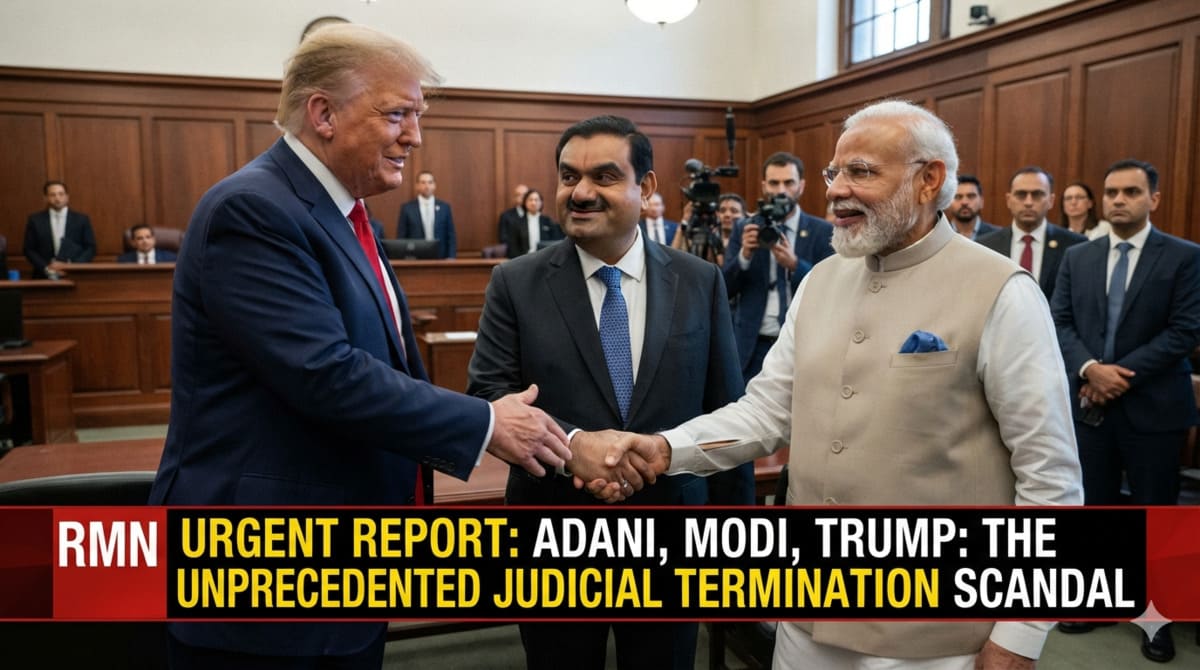
Trade Ransom: The Subversion of U.S. Justice for Gautam Adani’s Criminal Immunity
The permanent dismissal of U.S. federal criminal charges against Gautam Adani represents a terminal breakdown of institutional integrity, allegedly driven by a “trade ransom” where investment pledges were bartered for legal immunity. This investigation unmasks a sophisticated collusion between the Modi administration and U.S. executive power, effectively transforming federal indictments into negotiable assets within a $500 billion quid-pro-quo.
By Rakesh Raman
New Delhi | August 13, 2026
The Judicial Retreat in the Eastern District of New York
The U.S. federal court’s decision to abandon a high-profile criminal case against the Adani Group has sent shockwaves through the global community, raising concerns about the reach of legal accountability for powerful multinational corporations. On August 10, U.S. District Judge Nicholas Garaufis approved the Justice Department’s request to dismiss key charges, including securities-fraud conspiracy and wire-fraud conspiracy, against Gautam Adani, Sagar Adani, and Vneet Jaain.
Crucially, these charges were dismissed “with prejudice,” a legal designation that ensures they can never be refiled. While this ruling closes a major chapter of the prosecution, Judge Garaufis clarified that the dismissal was an exercise of “prosecutorial discretion” rather than an exoneration based on evidence. This distinction suggests that the decision to halt the $250 million bribery case was a political choice made by the U.S. Department of Justice, not a reflection of the case’s actual merits.
The Mechanics of the $500 Billion “Trade Ransom”
At the heart of this controversy is the concept of “trade ransom,” where criminal immunity is essentially bartered for economic or political concessions. Evidence suggests that massive investment pledges from the Adani conglomerate functioned as “down payments for criminal immunity,” signaling a collapse of the U.S. anti-corruption framework into a pay-for-play system.
This transnational exchange has allegedly compromised Indian sovereignty, as the Modi administration appears to be sacrificing national policy and regulatory control in vital sectors like energy and agriculture to secure Adani’s legal safety. By treating federal indictments as negotiable commodities, the involved parties have effectively hollowed out the credibility of international law.
Political Fallout: The “Compromised PM”
The dismissal has triggered a fierce domestic crisis in India. Rahul Gandhi, Leader of the Opposition, has characterized Prime Minister Narendra Modi as a “compromised PM” who has sold out national interests to protect a corporate ally. Gandhi asserted that “India is paying a huge price” for this arrangement, fueling intense parliamentary protests through late 2024.
However, Gandhi himself faces criticism regarding his effectiveness, with tools like the “Barking Dog Tracker” highlighting a gap between his digital rhetoric and actual grassroots mobilization. This lack of sustained domestic pressure has shifted the focus toward the urgent need for international oversight.
Calls for International Accountability
When the executive branch fails to maintain standard operating procedures due to foreign influence, the responsibility for transparency falls to the legislature. In response, independent journalist Rakesh Raman has submitted a formal memorandum to the Senate Committee on the Judiciary and the Helsinki Commission.
This memorandum, backed by the “India Corruption Research Report 2025,” demands urgent legislative action to prevent the American justice system from being auctioned to the highest foreign bidder. The global stakes remain high; if justice becomes a negotiable commodity in a geopolitical barter, the era of American institutional integrity may effectively be over.
By Rakesh Raman, who is a national award-winning journalist and social activist. He is the founder of the humanitarian organization RMN Foundation which is working in diverse areas to help the disadvantaged and distressed people in the society.
💛 Support Independent Journalism
If you find RMN News useful, please consider supporting us.