


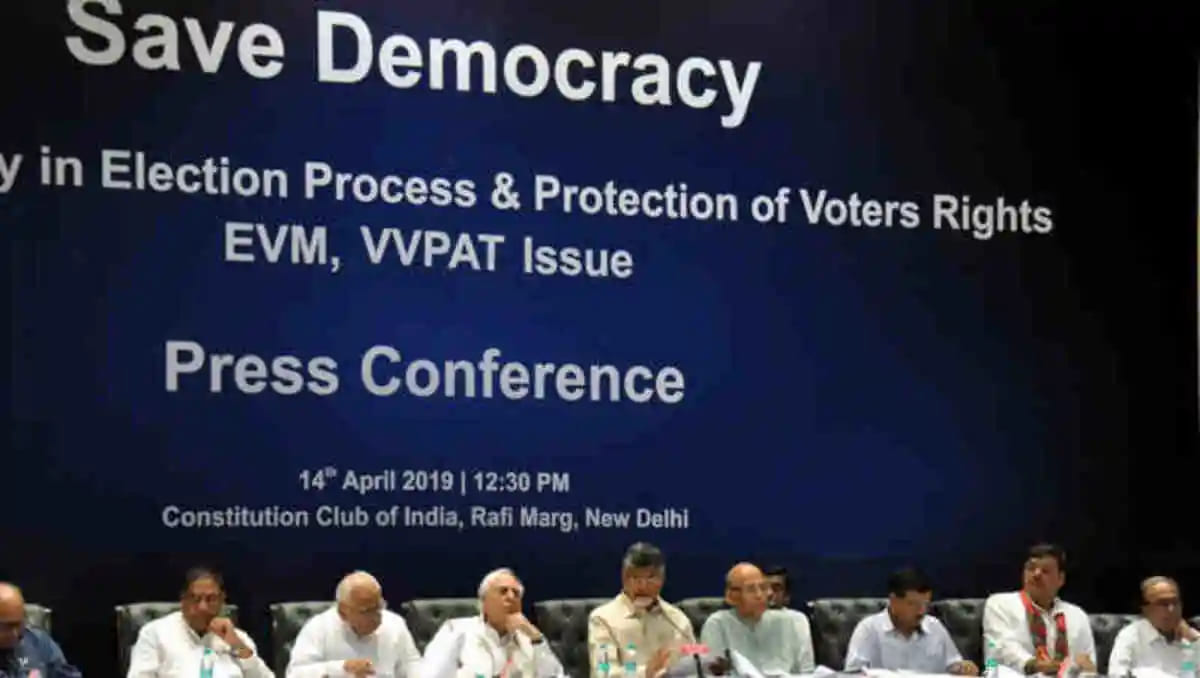
Managed Mandates: How EVM Manipulation and Institutional Capture Decayed India’s Democratic Integrity
India’s descent into an “electoral autocracy” is facilitated by systemic technical anomalies and the suppression of verifiable data trails. Evidence of impossible voting speeds and institutional capture suggests a managed mandate designed to bypass democratic safeguards and maintain the illusion of continuity.
By Rakesh Raman
New Delhi | May 23, 2026
1. The Mechanics of Impossibility: Statistical Anomalies in the 2024 Mandate
In the field of modern electoral forensics, technical data serves as the “smoking gun” that transcends anecdotal complaints. When the physical constraints of voting hardware are bypassed by reported turnout figures, the electronic voting architecture loses its claim to integrity. Investigative analysis into the 2024 mandate suggests that the current system has moved beyond physical possibility, entering the realm of manufactured outcomes where hardware limitations no longer govern the tally.
A critical point of failure lies in the “14-second reset” limitation of Electronic Voting Machines (EVMs). Mechanically, an EVM requires a minimum of 14 seconds to process and reset between each individual vote. However, investigative findings from specific booths during the 2024 elections revealed a “fraudulent peak” where votes were recorded as fast as one every six seconds. This discrepancy represents a documented breach of technical protocols and a physical impossibility, suggesting that votes were logged without the presence of actual voters.
This pattern of anomalies is further evidenced by the “Midnight Surge” across the national landscape, most notably in the Andhra Pradesh elections. Data synthesized by economist Parakala Prabhakar reveals that approximately 17 lakh votes were recorded in the narrow window between 11:45 PM and 2 AM. Staggeringly, a broader analysis of 3,500 booths shows nearly 52 lakh total votes were cast in the late-night window between 8 PM and 2 AM. This pattern defies conventional voter behavior and hints at clandestine entries made after polling should have concluded.
Reported Turnout vs. Technical Feasibility
| Metric | Official/Technical Limit | Reported/Observed Data | Discrepancy |
| Reset Speed | 14 seconds per vote | 6 seconds per vote (Peak) | Physical Impossibility |
| Turnout (Initial 5 PM) | N/A | 68.04% | Baseline anomaly |
| Turnout (Midnight) | N/A | 76.50% | 8.46% surge |
| Final Turnout (4 Days Later) | N/A | 81.79% | 13.75% total revision |
| Late Night Surge (8PM-2AM) | Minimal Expected | 52 Lakh votes (3,500 booths) | Statistically Abnormal |
These physical and statistical anomalies are not merely clerical errors; they are directly linked to the deliberate suppression of the data trails required to verify them.
2. Institutional Capture and the Rise of “Dark Democracy”
Transparency in documentation—specifically the public release of booth-level vote counts (Form 17C) and final result sheets (Form 20)—serves as the final safeguard against state overreach. The current refusal by the Election Commission of India (ECI) to disclose these records signals a transition into “dark democracy,” where the state operates behind closed doors to produce unverified results. This transparency deficit is compounded by the ECI’s refusal to provide voter lists in machine-readable formats, which strategically cripples the ability of independent auditors to identify duplicate entries or “fudged” rolls.
🔊 भारत का ईवीएम संकट: ऑडियो विश्लेषण
Senior Advocate Prashant Bhushan and former Chief Election Commissioner SY Quraishi have issued stark warnings that “democracy can’t run in the dark,” yet the ECI remains steadfast in its opacity. The Voter Verifiable Paper Audit Trail (VVPAT) system, intended to provide security, has instead become a “black box.” Mismatches between electronic records and physical slips are frequently reported, yet the lack of a 100% manual count renders the system vulnerable to selective manipulation.
Investigative documentation from Rakesh Raman and the RMN Foundation reveals a troubling “legacy of dismissal” within both the ECI and the Supreme Court. Both bodies have consistently rejected substantive fraud complaints without conducting the public technical audits required to restore trust, effectively dismantling domestic oversight. This domestic opacity has reached a critical mass, forcing international watchdogs to re-evaluate India’s standing as a democratic nation.
3. International Verdict: From Democracy to “Electoral Autocracy”
The geopolitical impact of India’s democratic downgrade is profound, as international classifications now serve as a mirror to domestic institutional failure. As the world’s most populous nation adopts increasingly autocratic structures, global institutions are re-categorizing the regime to reflect a reality of systematic hollowing out of democratic norms.
The 2026 V-Dem Institute report, “Unraveling the Democratic Era?“, officially classifies India as an “electoral autocracy.” This classification groups India with China, Indonesia, and Pakistan, citing the systematic dismantling of the pillars of self-governance. Analysts point to a “North Korean” facade where the regime allows minor opposition wins in non-critical states to maintain a global image of competition. This strategy mirrors the North Korean regime’s recent recording of a 0.07% “no” vote—the first since 1957—intended to manufacture a “realistic” image for the international community while maintaining an absolute grip on the levers of power.
The Global Context
- UN/IPU Oversight: Civil society and the RMN Foundation have launched mounting calls for the United Nations and the Inter-Parliamentary Union (IPU) to supervise future Indian elections to bypass compromised domestic agencies.
- Kofi Annan’s Warning: Former UN Secretary-General Kofi Annan warned that compromised elections do not just produce flawed leaders; they undermine the very legitimacy of the state.
This global shift in perception highlights how international metrics have begun to pierce the domestic “smokescreen” used by the regime to manage public perception.
4. Narrative Management: National Security and the Cinematic Smokescreen
To distract from electoral criminality, the regime employs a strategy of “Gleichschaltung“—the total coordination of cultural and security apparatuses to serve state interests. This concept involves using hyper-nationalist rhetoric and manufactured security crises to divert public attention away from the mechanics of election theft and the “fudging” of electoral rolls.
National security frequently serves as the primary distraction, with rhetoric regarding terrorism and military escalations strategically timed to coincide with domestic democratic decay. Parallel to this, the regime has co-opted the film industry to manufacture a cult of personality. Productions such as Dhurandhar, Matrubhoomi, and Battle of Galwan serve as cinematic cloaks to hide policy failures.
Critically, investigative reports expose “systemic box office data laundering,” where fraudulent financial records are used to manufacture an illusion of overwhelming public support for these state-aligned narratives. This cultural data laundering serves to mirror and validate the manufactured success of the elections themselves, creating a self-reinforcing loop of perceived legitimacy. This manufactured narrative stands in stark contrast to the lived reality of socio-economic distress, leading to a growing demand for a return to physical, auditable processes.
5. The Path to Restoration: The Case for Ballot Papers
The restoration of electoral integrity is no longer a political preference but a matter of state survival. There is an increasing consensus among regional governments and international experts that the only way to ensure transparency is a return to physical, auditable processes.
A regional push is already underway. Karnataka Law Minister HK Patil recently led the state cabinet to recommend that all future local body elections be conducted using paper ballots, citing the “eroded credibility” of EVMs. Similarly, the Punjab & Haryana High Court has observed that the statutory framework consciously retains the option for ballot papers to address ground realities and logistical constraints, asserting that authorities may revert from EVMs whenever needed to ensure free and fair polls.
This domestic push aligns with global advocacy. Figures such as Elon Musk have warned that EVM risks from human or AI-driven hacking are “too high,” specifically citing Argentina’s ability to hand-count 27 million paper ballots in under six hours as proof that the ECI’s “logistical impossibility” argument is a fallacy.
The Three Non-Negotiable Reforms
- 100% VVPAT Verification: Mandatory manual counting and verification of all paper slips to reconcile electronic totals.
- Real-Time Disclosure: Immediate release of real-time polling percentages on the day of voting to prevent post-polling surges.
- Public Release of Form 17C and Form 20: Transparent, immediate disclosure of booth-level summaries and final result sheets to the public and auditors.
The legitimacy of the Indian state is in terminal decline so long as its mandates are managed through opaque electronic systems. Without a transition back to paper ballots or the implementation of fully transparent, internationally supervised audits, the world’s largest democracy remains a manufactured illusion.
By Rakesh Raman, who is a national award-winning journalist and social activist. He is the founder of a humanitarian organization RMN Foundation which is working in diverse areas to help the disadvantaged and distressed people in the society.
💛 Support Independent Journalism
If you find RMN News useful, please consider supporting us.