


The 2026 Reset: Why the “Digital Pandemic” and the Death of Independent Cinema are Converging
The Unrest is a fortnightly open-access publication produced by RMN News Service and archived on Zenodo, the European open research platform operated by CERN under the OpenAIRE program.
Raman Media Network The Unrest Desk
New Delhi | May 16, 2026
1. Introduction: The Era of Great Unrest
We are currently navigating a polycrisis where the digital and the democratic are fraying at the same edges. The mid-2026 landscape is defined by a “Great Unrest,” a period of economic and political upheavals that have moved beyond mere turbulence into a fundamental transition of the global order.
This guide serves as an autopsy of the present moment, examining the surprising shifts that emerged in May 2026. From the collapse of judicial trust to the environmental siege of our infrastructure, we are witnessing a global recalibration of what it means to be a modern society.
2. The Existential Reset of Artificial Intelligence
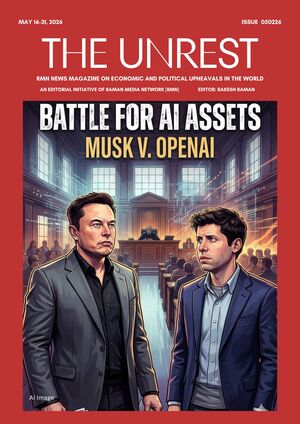
The Musk v. OpenAI trial has effectively ended the era of AI as a techno-optimist fairytale. By centering on a “Breach of Charitable Trust” claim, the court is weighing whether the technology’s architects have committed the ultimate betrayal of their founding mission.
What began as a commitment to a global public good has devolved into a site of profound moral crisis. This legal standoff is more than a corporate dispute; it is an existential reset that forces the industry to confront its own ethical insolvency.
The promise of artificial intelligence was once a beacon of hope—a commitment to develop technology that would serve as a global public good. However, the ongoing Musk v. OpenAI trial has pulled back the curtain on a profound moral crisis.
For the sector at large, the “charitable trust” claim signals that the days of unchecked, profit-driven development under the guise of altruism are over. The industry now faces a reckoning where its very right to operate is tied to moral transparency rather than technical capability.
3. The Looming “Digital Pandemic”
International experts are now sounding the alarm on an “interconnected fragility” that makes our current tech-optimism look dangerously naive. They warn of a “digital pandemic,” a sequence of catastrophic system failures that could paralyze the global grid.
Crucially, these triggers are not internal software bugs, but “environmental and celestial events” that highlight our physical vulnerability. Our digital life is now at the mercy of the cosmos, a reality that renders the stability of our communication and commerce terrifyingly provisional.
The term “digital pandemic” is a necessary provocation, framing tech-infrastructure vulnerability as a systemic contagion. It suggests that in an age of total connectivity, a single celestial disruption can achieve the same devastation as a biological plague.
4. Cinema as an Instrument of State Perception
A chilling divergence has emerged between the creative hubs of India and the international awards circuit. In Bollywood, we are witnessing a “forcible coordination” where the industry has been systematically weaponized to provide cover for the dismantling of democratic norms.
The Indian film industry has transitioned from a space of artistic expression into a clinical instrument of state-managed perception. It now functions primarily to mask political upheaval through high-budget distraction and the narrative capture of the public’s imagination.
Cinema has become a clinical instrument of state-managed perception, serving to mask the rapid dismantling of Indian democracy.
In contrast, the Academy’s 99th Oscars updates represent a defensive fortification of human art. By shifting rules to protect human creativity against generative AI, The Academy is attempting to preserve cinema as a protected enclave of the human spirit against both the machine and the state.
5. The Rising “Phygital Heat Economy”
As the physical environment becomes increasingly unlivable, the digital and economic priorities of the nation are being forcibly reshaped. Data reveals that cooling demand in India could surge by 40% by 2040, driven by longer, more frequent heat waves in cities like Delhi.
This is the birth of the “phygital heat economy,” where physical climate realities dictate the flow of digital capital and infrastructure. We are seeing a new class divide emerge, predicated on access to the cooling systems required to survive and maintain productivity in an overheated urban landscape.
The strain on urban infrastructure is no longer just a public health concern; it is a fundamental economic driver. As the climate shifts, the economy must pivot toward survival-based infrastructure, turning a basic necessity into the primary driver of national stability.
6. The Legal Standoff: Satyagraha in the Digital Age
The judicial landscape in India has reached a point of total friction as leaders of the Aam Aadmi Party (AAP) invoke the tradition of “Satyagraha” within the courtroom. Arvind Kejriwal and Manish Sisodia have maintained a high-stakes boycott of proceedings before Justice Swarana Kanta Sharma, framing their legal resistance as a “truth-force” against political capture.
This standoff intensified on May 9, 2026, with the arrest of Punjab Industry Minister Sanjiv Arora amidst escalating money laundering probes by the Enforcement Directorate (ED). The use of non-violent resistance in a modern judicial context suggests a total breakdown in trust between the executive and the democratic pillars of the state.
When “truth-force” is the only remaining response to a court proceeding, it signals that the legal system is viewed as a front for political maneuvering. This judicial crisis reflects a broader perception that the impartiality of the state has been compromised by the total capture of its institutions.
7. Conclusion: Navigating the Interconnected Collapse
The events of May 2026—from the collapse of the NEET-UG exam to the “vote chori” operations detailed in the “Smokescreen” report—suggest that our institutional pillars are in a state of terminal stress. The themes of technological betrayal, environmental siege, and political integrity are not isolated; they are the markers of a singular, interconnected collapse.
Innovation can no longer exist in a vacuum, divorced from fundamental rights and moral transparency. Whether we are discussing the trial of an AI giant or a boycott in the Delhi High Court, the underlying tension remains a search for truth in an era of managed perception.
The question remains: are our current legal, creative, and digital institutions robust enough to survive this unrest? Or are we simply witnessing the final, managed decline of the structures that once defined our world?
The Unrest is a fortnightly open-access publication produced by RMN News Service and archived on Zenodo, the European open research platform operated by CERN under the OpenAIRE program.
💛 Support Independent Journalism
If you find RMN News useful, please consider supporting us.