


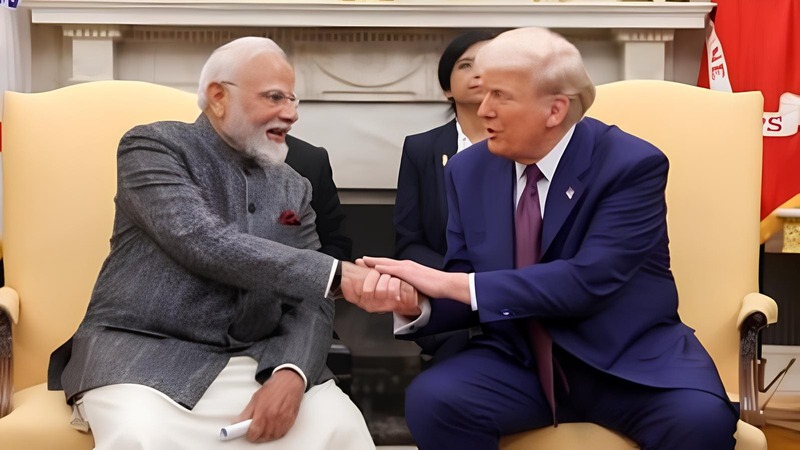
Deconstructing the Modi Smokescreen: Why Trump’s Praise Ignores India’s Economic Decay and Institutional Capture
While Donald Trump lauds Prime Minister Narendra Modi’s leadership and “very good numbers,” RMN News data reveals a staggering 3.6x increase in national debt and a 96.5% collapse in Net FDI. This investigative analysis exposes an “electoral autocracy” characterized by systemic institutional capture and a projected 50-year recovery horizon for India’s democratic fabric.
Raman Media Network Political Desk
New Delhi | June 21, 2026
The Rhetoric of Recognition vs. The Reality of Research
In the arena of global geopolitics, high-level diplomatic endorsements often serve as a “halo effect” that shields regimes from domestic accountability. US President Donald Trump has consistently characterized Narendra Modi as a “tough cookie” and a “great leader” with “solid” numbers. However, the RMN News “Smokescreen” project deconstructs this rhetoric, transitioning from performative global summits to unvarnished fiscal and institutional data.
Also Read:
[ Rahul Gandhi: The Barking Dog of Indian Politics? ]
The Economic Paradox: Exploding Debt and Capital Flight
Trump’s praise for India’s economic performance stands in direct opposition to the “layman’s economics” of debt and survival. Under the Modi administration, Central Government debt has surged from ₹55 lakh crore in 2014 to over ₹197 lakh crore in 2026—a 3.6x explosion that represents a generational mortgage.
Furthermore, the “Make in India” narrative is challenged by a 96.5% collapse in Net FDI, which plummeted to just $353 million in FY25. This massive capital flight indicates that foreign investors are actively fleeing the Indian market, signaling a profound lack of global confidence in the regime’s stability.
Institutional Capture and the “Electoral Autocracy”
The perceived stability of Modi’s leadership is maintained through what researchers term “institutional capture”. While the shell of elections remains, international organizations like Sweden’s V-Dem now formally classify India as an “electoral autocracy” due to the systematic erosion of checks and balances.
Key indicators of this decay include:
- Weaponization of Agencies: The state has utilized the Enforcement Directorate (ED) and CBI to target political rivals and criminalize dissent.
- Electoral Vulnerabilities: Research documents persistent issues with Electronic Voting Machines (EVMs) and the arbitrary deletion of local electoral rolls.
- Corporate Oligarchy: A deep state-corporate alliance, notably the Modi-Adani collusion, has seen public wealth transferred to singular corporate entities.
The Human and Social Cost
The “Smokescreen” research also highlights a chilling culture of impunity, noting a timeline of “uninvestigated fatalities” involving individuals who challenged the establishment, such as Judge B.H. Loya. Socially, the claim of organic prosperity is deconstructed by the fact that 80 crore citizens—nearly 60% of the population—are currently dependent on free government rations for basic survival.
[ Video: ट्रंप ने कहा कि मोदी एक सफल नेता हैं। लेकिन सच क्या है? ]
Conclusion: A 50-Year Recovery Horizon
The structural damage identified over the past 12 years—from the destruction of institutional independence to the ₹197 lakh crore debt trap—cannot be easily repaired. Analysts conclude that India now faces a 50-year recovery horizon to mend its democratic and fiscal fabric. While global leaders may echo state-managed narratives for diplomatic convenience, independent data reveals a nation in deep institutional and economic distress.
This article is part of our ongoing research on Narendra Modi under the title: “Narendra Modi: Twelve Years of Misrule and the Illusion of Growth?“
💛 Support Independent Journalism
If you find RMN News useful, please consider supporting us.