


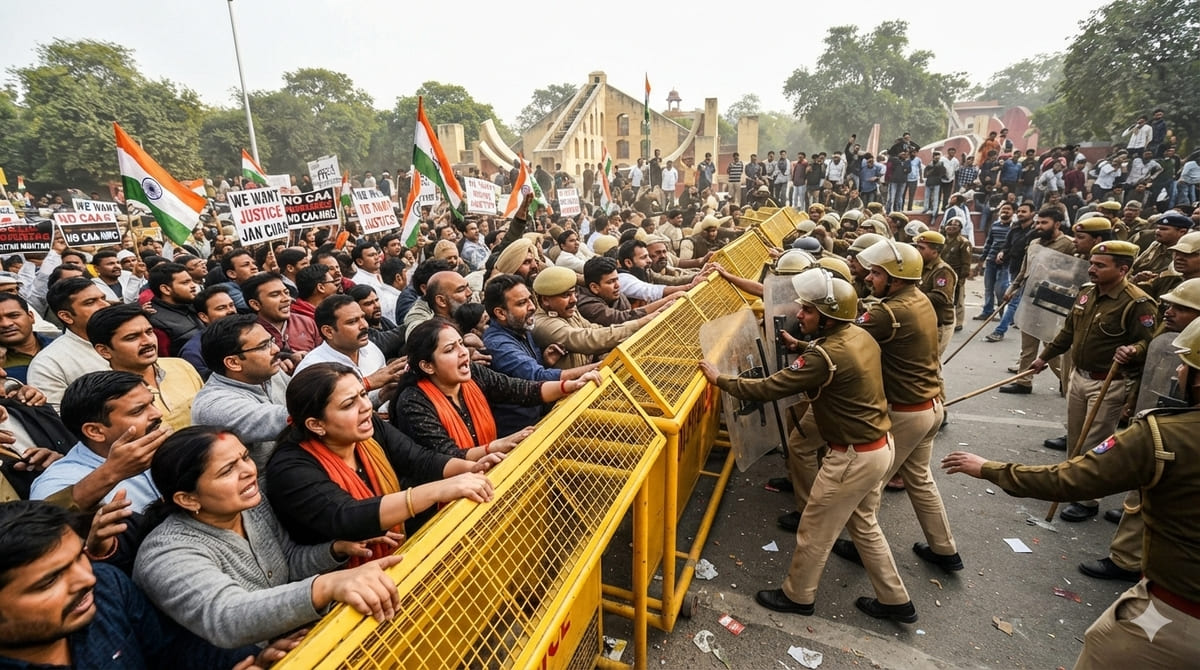
Pralhad Joshi Gets Additional Charge of Education Ministry as Dharmendra Pradhan Resigns Amid Jantar Mantar Protests
Union Minister Pralhad Joshi has been assigned additional charge of the Ministry of Education following Dharmendra Pradhan’s resignation on July 25 amid widespread protests over exam paper leaks. The move highlights the Modi government’s pattern of appointing ministers based on political loyalty rather than academic expertise or administrative merit. Meanwhile, student protests at Jantar Mantar, led by the Cockroach Janta Party (CJP), ended without securing meaningful education reforms.
Raman Media Network Political Desk
New Delhi | July 26, 2026
In a significant development on July 25, the President’s office accepted the resignation of Education Minister Dharmendra Pradhan and handed additional charge of the Ministry of Education to Union Minister Pralhad Joshi. Joshi, who currently oversees Consumer Affairs, Food and Public Distribution, steps into the role amid ongoing criticism of the government’s handling of recurring examination scandals and systemic issues in higher education.
The appointment comes shortly after sustained student protests at Jantar Mantar in Delhi demanding accountability for paper leaks and reforms in the education system. However, the agitation, primarily led by the Cockroach Janta Party (CJP), concluded abruptly after nearly a month without achieving substantive policy changes. Observers describe the minister’s resignation as a tactical move to defuse public pressure rather than a genuine step toward accountability.
Criticism Over Ministerial Competence and RSS Influence
Pralhad Joshi’s elevation to the education portfolio has drawn sharp scrutiny. Detractors argue that he lacks the academic or research credentials typically expected for overseeing India’s vast education system. His long association with the Rashtriya Swayamsevak Sangh (RSS) and the affiliated Akhil Bharatiya Vidyarthi Parishad (ABVP) has fueled opposition claims that key educational institutions are increasingly being influenced by ideological affiliations rather than merit-based selections.
This appointment fits a broader narrative critics attribute to the Modi government: ministerial positions are often decided by RSS loyalty or coalition compulsions instead of domain expertise. From the appointment of Smriti Irani as HRD Minister in 2014 — despite questions over her educational qualifications — to subsequent choices, the government has faced repeated accusations of showing scant respect for education as a priority sector.
Experts and opposition voices contend that such decisions reflect a deeper disinterest in overhauling India’s education system, which continues to struggle with producing employable graduates despite large-scale enrollment. Systemic challenges, including examination integrity, faculty quality, and institutional autonomy, remain largely unaddressed under successive ministers.
Symbolic Victory or Missed Opportunity?
The resignation of Dharmendra Pradhan and the quiet winding down of the Jantar Mantar protest are being viewed as a hollow victory for student agitators. While the removal of one minister created an illusion of responsiveness, the core machinery of governance and policy direction remains unchanged. The protesters endured harsh conditions but secured no concrete reforms on paper leaks, syllabus rationalization, or institutional accountability.
As Pralhad Joshi assumes additional responsibility, the spotlight remains on whether the Ministry of Education will see meaningful reform or continue along the path of politically convenient appointments. For millions of Indian students and parents, the stakes are high: the future of the country’s human capital depends on competent leadership and genuine commitment to educational excellence.
💛 Support Independent Journalism
If you find RMN News useful, please consider supporting us.