


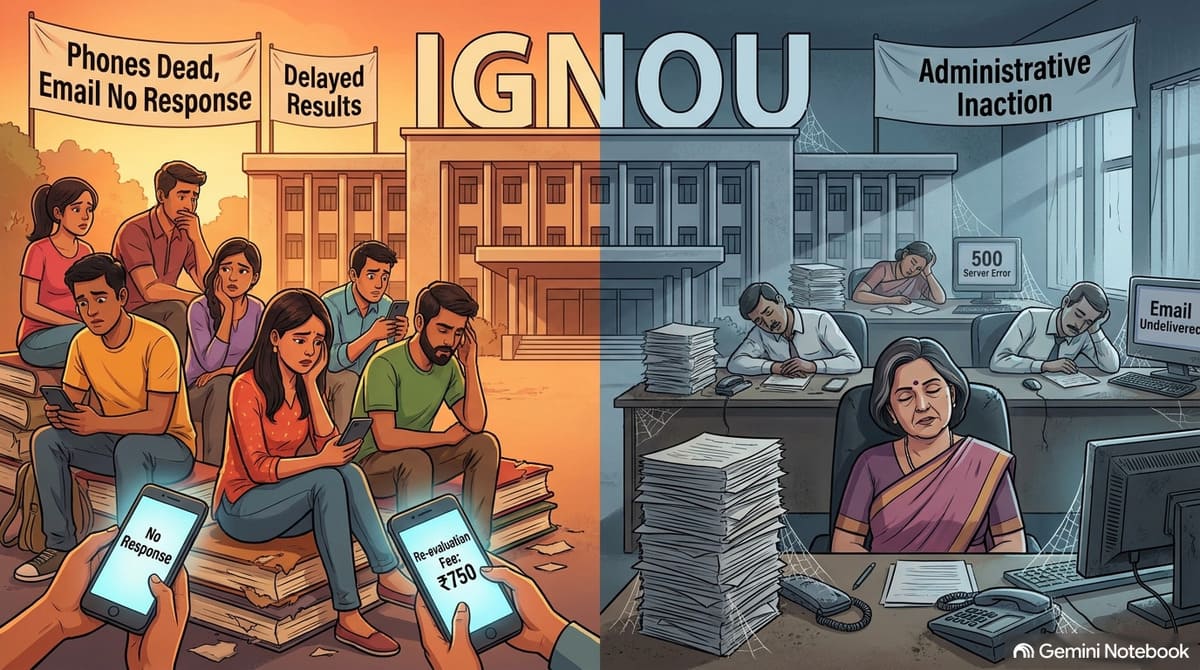
IGNOU Grievance Crisis and CPGRAMS Failure
Systemic Operational Failure at IGNOU and Bureaucratic Inaction on CPGRAMS Demand Presidential Intervention
Widespread administrative bottlenecks at the Indira Gandhi National Open University have left over thirty-five lakh distance education learners facing severe academic delays in examination results, assignment grading, and study material dispatches. Despite formal editorial warnings and statutory complaints submitted under Section 8 of the IGNOU Act, central grievance officials improperly redirected the case back to the accused university administration, which summarily closed the matter. A formal appeal now demands a presidential inquiry and an independent investigation into university management and official delinquency.
Raman Media Network Education Desk
New Delhi | November 4, 2026
The Indira Gandhi National Open University, established under an Act of Parliament in 1985 to democratize access to higher education, is currently experiencing a profound operational breakdown across its vast educational network. Serving an estimated enrollment base exceeding thirty-five lakh students across India and international study centers, the institution is legally obligated to maintain transparency, administrative efficiency, and prompt grievance resolution.
However, documented findings compiled by consumer protection networks reveal chronic administrative bottlenecks that severely jeopardize the academic progress and career mobility of distance learners. Key operational default areas include multi-month delays in declaring Term-End Examination results well beyond the mandatory forty-five-day prospectus timeline, persistent discrepancies in assignment record processing, extended delays in delivering physical study modules, and an overarching lack of communication from university regional desks.
The real-world consequences of these administrative failures extend far beyond routine institutional delays. Students routinely report that physical assignment scripts submitted to study centers months in advance continue to display as not submitted or remain entirely blank on official digital Grade Cards. Furthermore, the dispatch of essential textbooks is frequently delayed by months or even a full academic year, forcing vulnerable learners to purchase expensive third-party commercial study guides.
[ IGNOU प्रशासनिक विफलता और CPGRAMS नौकरशाही: ऑडियो विश्लेषण ]
In several instances, distribution channels have exhibited severe logistical errors, such as dispatching multiple duplicate copies of a single course text while omitting core syllabus materials altogether. Evaluation integrity has also come under intense scrutiny, with learners alleging that answer scripts remain inadequately checked or carry cover pages marked without evaluator signatures. To seek rectifications for potential grading errors, students are subjected to a steep re-evaluation fee of seven hundred fifty rupees per paper. Meanwhile, official telephone helplines and email channels remain unresponsive, while the central university grievance portal, known as iGRAM, remains functionally dormant.
Because updated examination marks and assignment scores are required to issue final Grade Cards and degree certificates, these administrative bottlenecks force distance education students into unintended term or year gaps. Enrolled learners consequently face missed deadlines for higher education admissions and remain unable to verify their qualifications for competitive employment opportunities.
In response to these unaddressed systemic defaults, independent media oversight was initiated to demand institutional accountability. Journalist Rakesh Raman, representing the RMN News Service and the RMN Consumer Rights Network, served a formal editorial notice on October 10, 2026, to IGNOU Vice-Chancellor Professor Uma Kanjilal. The notice detailed widespread student grievances, requested a transparent action plan, and set an explicit response deadline of October 15, 2026. However, university leadership responded with complete silence, offering no written acknowledgment, remedial timelines, or official explanations.
Following the expiration of the editorial notice, a formal statutory complaint was lodged on October 30, 2026, invoking Section 8 of the IGNOU Act, 1985. Addressed to the President of India in her capacity as Visitor of the University, as well as the Secretary of the Department of Higher Education, the complaint was submitted through the Centralized Public Grievance Redress and Monitoring System, known as CPGRAMS, alongside the President’s Secretariat portal. The statutory filing sought a comprehensive sixty-day independent inspection into university operations, the operational restoration of student grievance portals, binding timelines for clearing backlogged academic records, and formal accountability measures for delinquent officers.
Despite the statutory nature of the filing, the central public grievance machinery demonstrated severe procedural failures. On November 2, 2026, central administrative officials improperly transferred the complaint directly to the Student Support Centre of the accused university. This rerouting allowed the IGNOU administration to act as a judge in its own cause, violating fundamental principles of administrative fairness.
IGNOU officials subsequently closed the case, issuing a perfunctory statement claiming that public grievance channels handle only individual student complaints containing enrollment details, rather than macro-level operational inquiries. The university directed aggrieved students back to internal regional channels and the iGRAM portal, the exact mechanisms documented as non-functional in the original filing.
This perfunctory disposal prompted the immediate filing of a formal CPGRAMS appeal, condemning the arbitrary closure and pointing out that asking complainants to return to defunct internal portals perpetuates a systemic conflict of interest. Under Section 8 of the IGNOU Act, the President of India possesses ultimate supervisory authority to order an independent inquiry into university examinations, administration, and financial management.
The pending statutory appeal requests the immediate reopening of the complaint, the issuance of a formal notice to the university, and a transparent investigation. It further demands that executive authorities refrain from closing complaints based on superficial assurances, requiring instead a reasoned speaking order based on verified findings to restore institutional integrity and protect student rights.
💛 Support Independent Journalism
If you find RMN News useful, please consider supporting us.