


The Deceptive Theater of Jantar Mantar: Why the CJP Protest and Wangchuk Strike Collapsed Under Strategic Vacuity
The CJP’s Jantar Mantar protest and Sonam Wangchuk’s hunger strike have collapsed, revealing a strategic vacuum and a reliance on stage-managed theatrics. Rendered irrelevant by state force and vague demands, the movement has devolved into a tactical surrender from hospital beds and brief, inconsequential government meetings.
Raman Media Network Political Desk
New Delhi | July 20, 2026
The July 20 Crackdown: A Movement Rendered Dead
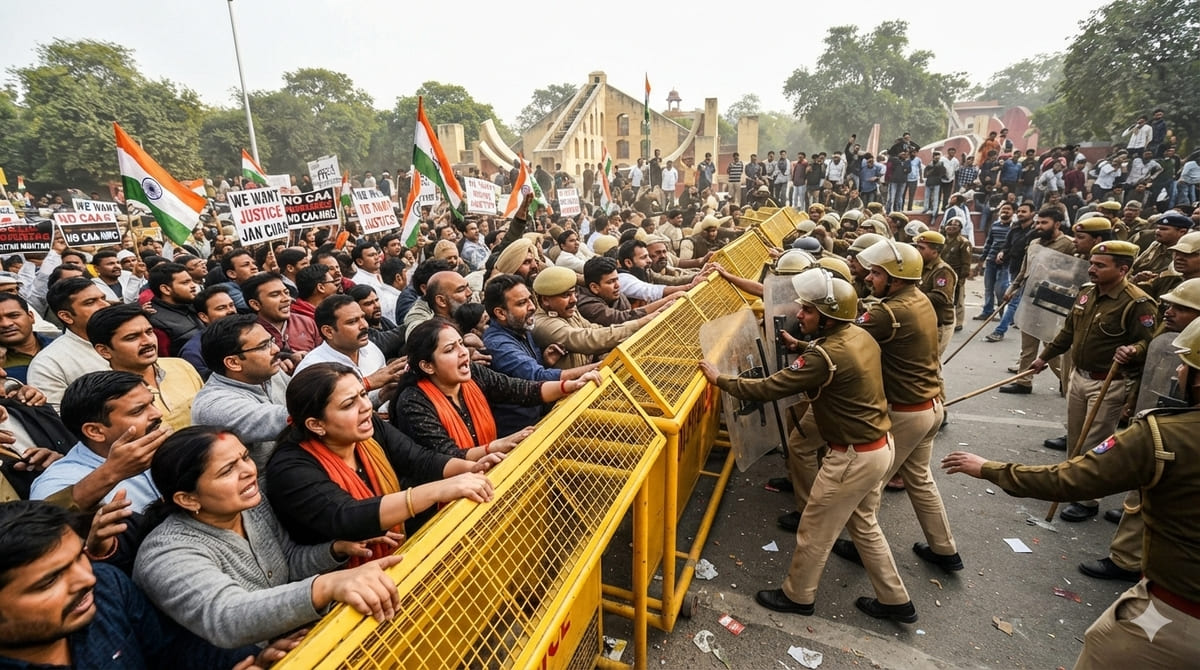
The Jantar Mantar protest, led by the Cockroach Janta Party (CJP), reached a terminal collapse on July 20, 2026, when its march toward Parliament was decisively halted. The movement, which sought accountability for NEET paper leak scandals, was neutralized by the Delhi Police through the systematic use of brute force, including lathi-charges and tear gas. This crackdown highlighted a total loss of leverage against a state apparatus that views such intervention as an effective tool for order rather than a scandal.
While some digital narratives attempted to frame the dispersal as a temporary setback, the movement is functionally dead; it lacks the critical mass and tactical pressure required to influence an administration that maintains a firm autocratic posture. The swift transition from street-level conflict to a mere ten-minute meeting with Union Minister JP Nadda served as a scripted de-escalation trap, successfully pivoting optics from state violence to a “cordial” but empty administrative discussion.
The CJP movement is functionally dead, rendered a casualty of its own strategic vacuity and the state’s uncompromising use of force.
Sonam Wangchuk’s “Medical Exit” and the Farce of Martyrdom
A central figure in this failure is activist Sonam Wangchuk, whose nearly 20-day hunger strike has been critiqued as a choreographed piece of political theater. On July 18, Wangchuk staged a “medical exit” to Safdarjung Hospital, a move viewed by critics as a tactical surrender designed to avoid the indignity of admitting defeat. From the air-conditioned comfort of a hospital bed, Wangchuk transitioned his narrative into one of “illegal detention,” converting a stalling protest into a manufactured brand of state-imposed martyrdom.
Wangchuk’s demands have been characterized by an architecture of vagueness. His conditions for ending the fast—such as vague “accountability” for education failures and hospital visits from top leaders—reveal a focus on personal brand validation rather than systemic reform. This “hype-based activism” caters more to global media consumption and international accolades than to the actual needs of victimized students.
Sonam Wangchuk’s hospital exit was a masterclass in face-saving maneuvers, converting a failing protest into a narrative of manufactured martyrdom.
The Business of Dissent and Strategic Failure
The protest’s failure was further compounded by its leadership and composition. The movement has become a magnet for “hired crowds,” retired actors, and unscrupulous politicians, delegitimizing the grievances and turning the site into a “theater of the absurd”. Strategic errors, such as demanding financial handouts and the resignation of “slave” ministers like Dharmendra Pradhan—who hold no independent power in a one-man regime—ensured the administration remained unmoved.
Ultimately, the Modi administration’s refusal to grant concessions serves as a prophylactic measure against “street-level blackmail”. The CJP and Wangchuk have not just lost the battle for Jantar Mantar; they have rendered themselves footnotes in the history of failed Indian dissent.
💛 Support Independent Journalism
If you find RMN News useful, please consider supporting us.