


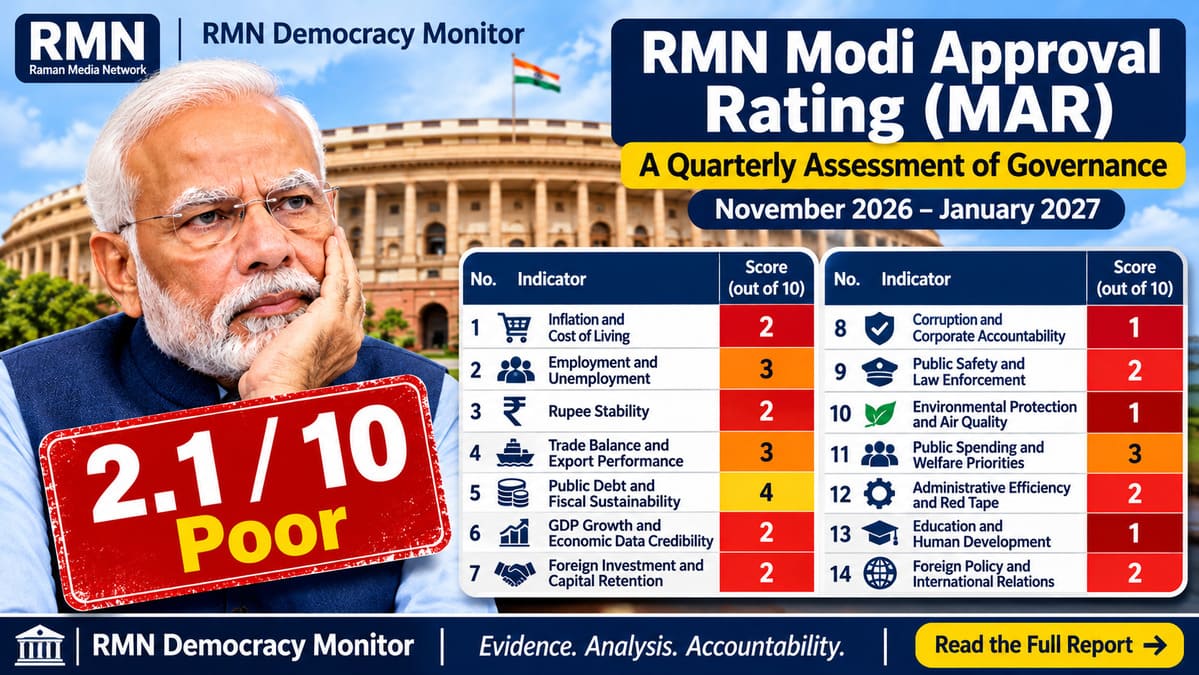
RMN Modi Approval Rating Hits 2.1/10
RMN Modi Approval Rating Provisional Score of 2.1 Out of 10 Signals Widespread Governance Shortfalls Across Economy, Corruption, Environment and Social Indicators
The provisional RMN Modi Approval Rating (MAR) for the November 2026–January 2027 period stands at 2.1 out of 10, classifying the Union government’s performance as Poor. Drawing on 14 equally weighted indicators spanning economic management, administrative integrity, social development and foreign policy, the assessment identifies acute weaknesses in corruption control, environmental protection, human development and data credibility. Unlike conventional opinion polls, the MAR framework evaluates governance by measuring the gap between official claims and verifiable outcomes.
Raman Media Network Research Desk
New Delhi | November 7, 2026
The provisional RMN Modi Approval Rating (MAR) has been released at 2.1 out of 10 for the assessment window covering 1 November 2026 to 31 January 2027. Published by Raman Media Network under its RMN Democracy Monitor initiative, the score places the performance of the government led by Prime Minister Narendra Modi in the “Poor” category.
Unlike traditional approval ratings that rely on public-opinion surveys, the MAR is an outcome-based editorial and research framework. It systematically compares official statistics, policy announcements and government claims against independent economic studies, international institutional analyses, investigative reporting, judicial records and observable citizen experiences. The overall rating is the simple arithmetic mean of 14 indicators, each carrying equal weight.
Provisional Scorecard
Key Sector Findings
Economic Management
Persistent retail inflation and elevated food prices continue to erode household purchasing power (2/10). Youth unemployment and underemployment remain structural challenges (3/10). The Indian rupee’s depreciation against the dollar has raised import costs (2/10), while structural trade deficits persist (3/10). Public-debt servicing obligations constrain fiscal space (4/10). Questions surrounding the credibility of headline GDP figures and net foreign-investment retention both score 2/10.
Governance and Integrity
Corruption and corporate accountability received the joint-lowest score of 1/10, reflecting concerns over political-corporate linkages, procurement practices and regulatory transparency. Administrative efficiency and bureaucratic red tape were rated 2/10.
Social Development and Environment
Environmental protection and air quality scored 1/10 amid hazardous pollution levels and enforcement gaps. Education and human-development indicators also registered 1/10, highlighting mismatches between formal qualifications and labour-market skills. Public safety and law-enforcement effectiveness stood at 2/10, while welfare-delivery priorities scored 3/10.
Foreign Policy
Diplomatic influence, trade negotiations and strategic outcomes were assessed at 2/10.
Methodology and Institutional Context
The MAR draws on seven data streams: official statistics and budget documents; independent academic and economic research; reports from international institutions; investigative journalism; judicial and regulatory filings; verified administrative developments; and measurable policy outcomes. Scores of 1–2 denote “Very Poor” performance (serious, persistent shortcomings); scores of 3–4 denote “Poor” performance (substantial deficiencies).
Raman Media Network maintains two complementary tracking tools. The RMN Democracy Monitor examines electoral integrity, civil liberties and institutional independence, while the MAR focuses specifically on executive governance performance across economic, administrative, social and foreign-policy domains.
The assessment is issued under the editorial leadership of Rakesh Raman, founder of Raman Media Network and a Country Expert for India with the Varieties of Democracy (V-Dem) Project at the University of Gothenburg.
The provisional 2.1 rating underscores persistent gaps between stated policy objectives and measurable results in core areas of economic management, institutional integrity, environmental stewardship and human development. Subsequent quarterly updates will track whether corrective measures narrow these gaps.
💛 Support Independent Journalism
If you find RMN News useful, please consider supporting us.