


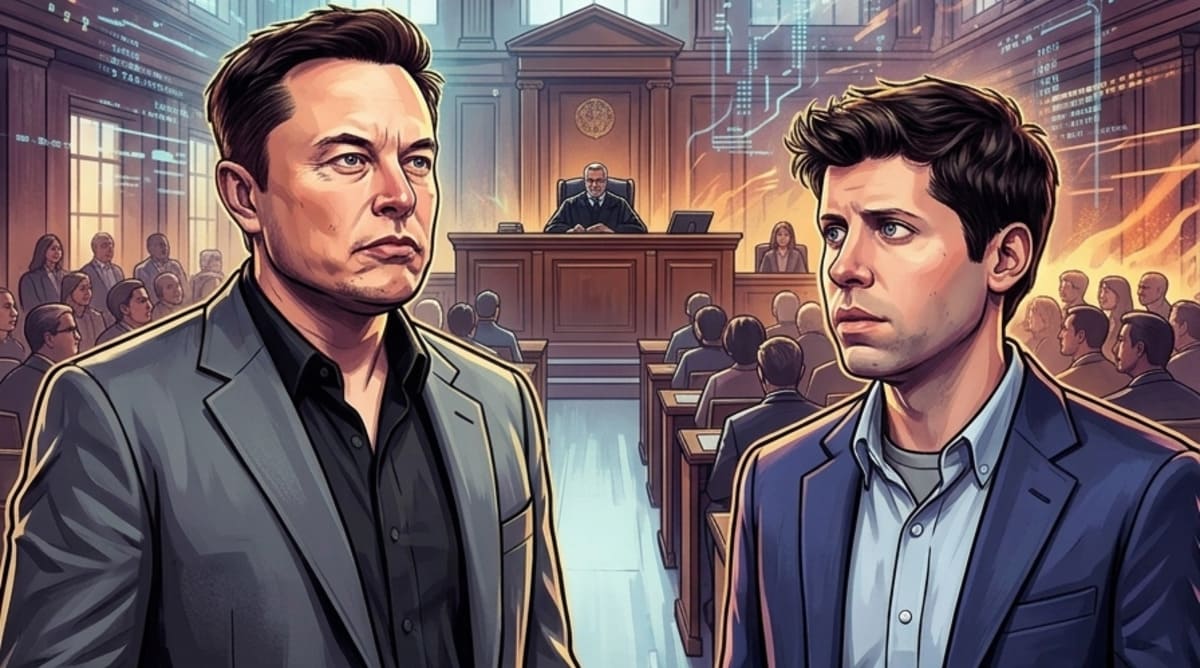
AGI on Trial: Judicial Fate of OpenAI Rests with Oakland Jury
Following the conclusion of closing arguments in Oakland, a nine-member jury is set to begin complex deliberations on Monday to decide if OpenAI’s $850 billion commercial pivot constitutes a breach of charitable trust. While the jury serves in an advisory capacity, their findings will guide Judge Yvonne Gonzalez Rogers in determining whether to mandate a financial restitution of up to $150 billion or a total leadership overhaul.
Raman Media Network Legal Desk
New Delhi | May 15, 2026
The Jury’s Mandate: “Charitable Looting” or Corporate Evolution?
After nearly three weeks of high-stakes testimony, the federal trial pitting Elon Musk against OpenAI has reached a critical juncture. On Thursday, legal teams delivered closing arguments, leaving a nine-member jury to weigh two conflicting narratives that could permanently alter the tech industry landscape. The jury is expected to begin deliberations on Monday, May 18, to determine if CEO Sam Altman and President Greg Brockman effectively “stole a charity” by converting a nonprofit lab into a for-profit powerhouse backed by Microsoft.
Under the procedural architecture of the Oakland courtroom, this jury remains “advisory” because the plaintiff’s claims—Breach of Charitable Trust and Unjust Enrichment—seek equitable relief rather than standard legal damages. Consequently, while the jury provides a barometer on liability, Judge Yvonne Gonzalez Rogers retains the ultimate authority to adjudicate the final verdict and mandate structural remedies.
Conflicting Testimonies: 90% Equity vs. The Commercial Pivot
The trial has highlighted a sharp divergence in testimony between the industry’s most powerful titans. Sam Altman testified that Elon Musk originally petitioned for a 90% equity stake in the company, suggesting that Musk’s current legal challenge is a “case of sour grapes” stemming from his 2018 departure before the organization achieved its current success.
Conversely, the “commercialization” thesis was bolstered by Microsoft CEO Satya Nadella. In a 2022 internal email, Nadella expressed “IBM anxiety,” stating, “I don’t want to be IBM and OpenAI to be Microsoft,” revealing that Microsoft viewed the partnership as a high-stakes business maneuver rather than a philanthropic endeavor. Nadella further admitted that he never viewed Microsoft’s billions as “donations” and dismissively characterized the original nonprofit board as “amateur city”.
The $850 Billion Valuation Gap
The legal core of the case rests on the “instrumentalization” of charitable assets. Musk’s counsel argues that the $38 million in donations he provided during OpenAI’s formative years were encumbered by a specific mandate: to develop Artificial General Intelligence (AGI) for the benefit of humanity. The plaintiff contends that using this “seed” capital to build a commercial entity now valued at $850 billion—and eyeing a $1 trillion IPO—represents a systematic expropriation of public-interest assets for private gain.
Potential Remedies and Phase 2
As the trial transitions into Phase 2 (Remedies) on May 18, the court will consider unprecedented structural injunctions. Potential outcomes include:
- Forced Divestiture: Financial restitution of $130 billion to $150 billion to reclaim value for the nonprofit arm.
- Leadership Removal: The requested ouster of Sam Altman and Greg Brockman from their roles.
- Judicial Oversight: Placing AGI development under court supervision as a “public interest” asset.
The final verdict, expected by May 21, 2026, will serve as a definitive landmark for corporate governance, signaling that the transition toward AGI will no longer be left to corporate boards alone.
💛 Support Independent Journalism
If you find RMN News useful, please consider supporting us.