


Why South Indian Cinema is Best Positioned to Forge India’s Global James Bond IP
South Indian cinema possesses the technical precision and specialized talent required to establish a sustainable, globally recognized espionage franchise. By moving away from formulaic Bollywood tropes and utilizing specific actor archetypes, the industry can create a sophisticated, multilingual intellectual property (IP) capable of competing on an international scale.
Raman Media Network Entertainment Desk
New Delhi | July 17, 2026
The Global IP Crisis and the Bollywood Failure
For decades, the Indian film industry has functioned as a high-volume content machine, often producing films with low narrative longevity that rely on short-term theatrical runs and manufactured box office hyperbole. While the world is increasingly dominated by enduring, transmedia global Intellectual Properties, India lacks a highly structured, sophisticated espionage franchise.
The solution to this crisis does not lie in Bollywood, where the spy genre has largely devolved into CGI-heavy spectacles prioritizing loud patriotism over complex character development and narrative integrity. To build an IP with international distribution value, Indian filmmakers must look toward a more grounded and intellectual core.
[ Also Read: Why South India Can Build the Next James Bond IP ]
The Hollywood Barrier: Bond 26 Rules
Understanding the architecture of a global franchise requires looking at the official James Bond gold standard. Currently, EON and Amazon MGM Studios maintain a strict rule: the actor playing James Bond must be a British or Commonwealth citizen. Additionally, for the upcoming Bond 26, the search is focused on “fresh faces” in their late 20s or mid-30s. Consequently, leading Indian actors—many of whom are in their 40s and hold Indian citizenship—are structurally excluded from the official Hollywood franchise.
The South Indian Blueprint for a Global Spy IP
To capture international markets, a legitimate Indian spy IP must be multilingual by design and grounded in archetypal storytelling rather than physics-defying action. South Indian cinema, known for its work ethic and gritty storytelling, offers the ideal talent pool to realize this vision through four distinct archetypes:
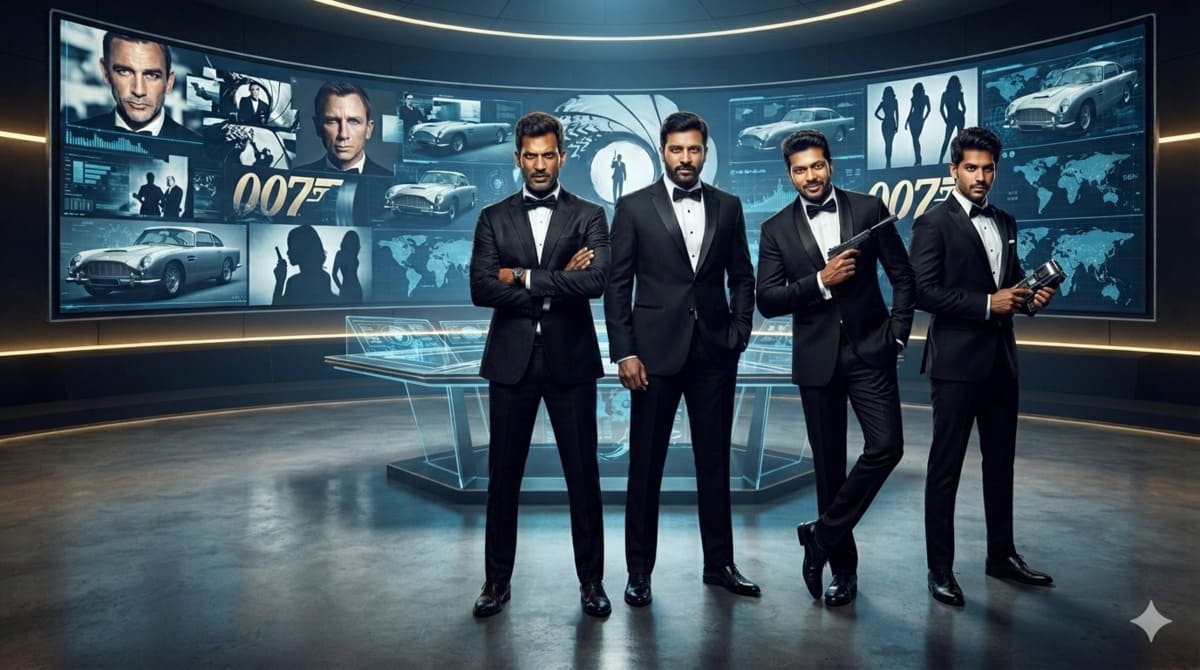
- The Raw and Relentless (Vishal): Representing the “Daniel Craig” archetype, Vishal’s rugged physique and experience in techno-thrillers like Irumbu Thirai make him ideal for a physically aggressive, tactical operative.
- The Suave and Elite (Jayam Ravi): Matching the “Pierce Brosnan” archetype, Ravi offers a sophisticated, calm screen presence perfect for high-society infiltration and psychological chess, as seen in Thani Oruvan.
- The Tactical Commando (Gopichand): Fitting the military intelligence side of espionage, Gopichand’s commanding physical presence and work in films like Sahasam suit high-intensity, cross-border extraction missions.
- The Undercover Specialist (Allari Naresh): As a “mind gamer” archetype, Naresh leverages his dramatic range and emotional grit to play cerebral operatives who outsmart syndicates through intellect rather than muscle.
Conclusion: A Strategic Shift
Instead of waiting for Hollywood’s casting rules to change, Indian producers must recognize the structural shift in global entertainment. By utilizing the specialized talent of the South Indian industry, writers can craft a high-concept, multilingual espionage universe that respects the audience’s intelligence and creates a lasting, profitable global IP.
💛 Support Independent Journalism
If you find RMN News useful, please consider supporting us.