


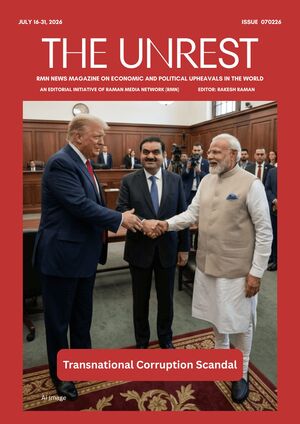
Transnational Corruption Scandal: US Court Intervenes in Adani Bribery Case Amidst Global Political Upheaval
In a severe blow to the Department of Justice’s attempt to bury a $250 million transnational bribery and securities fraud case, a US federal judge has demanded “quid pro quo” testimony from billionaire Gautam Adani. This judicial intervention exposes the deep-seated rot within a global system of impunity and serves as the epicenter of a broader landscape of institutional decay detailed in the July 16-31, 2026, issue of The Unrest.
Raman Media Network The Unrest Desk
New Delhi | July 16, 2026
The strategic importance of judicial independence has never been more apparent than in the current standoff involving the Adani Group. While the Department of Justice recently signaled an intent to drop the high-stakes indictment—an act widely condemned as a “travesty of justice“—the presiding federal judge has effectively blocked the dismissal. By ordering sworn testimony regarding illicit financial influence, the court has forced a public reckoning with allegations that threaten to collapse the narrative of corporate and political synergy currently propping up the Indian establishment. This is no longer merely a legal dispute; it is a direct challenge to the mechanics of state-sponsored corruption.
Indian Political Crisis: Twelve Years of Misrule and the Illusion of Growth
Narendra Modi’s twelve-year tenure reached a significant milestone in June 2026, marking him as India’s longest-serving Prime Minister. However, beneath the gloss of a heavily managed public relations machine, the reality is one of systemic erosion. The “Illusion of Growth” is being stripped away by a series of damning indicators: exploding national debt, a persistent flight of foreign capital, and stagnant joblessness.
Investigative inquiries have further clouded the administration’s reputation, specifically regarding a “Modi Award Racket” involving a controversial state honor. While questions mount, the Indonesian government has maintained a stone-faced institutional silence, refusing to clarify the circumstances of the award. Domestically, the fiscal recklessness of the executive is underscored by an expenditure of over ₹1,900 crore on the Prime Minister’s foreign travel—a sum critics argue has yielded no transparent returns for the public.
This leadership vacuum is mirrored by a crippled opposition. Rahul Gandhi continues to play the role of the “barking dog” of Indian politics; his frequent allegations of institutional capture and electoral fraud rarely transition into sustained political campaigns, effectively leaving the Modi administration electorally dominant. At the state level, the collapse is even more acute. The Punjab Congress is currently undergoing what analysts call “institutional suicide.” The party is paralyzed by corruption probes surrounding former CM Charanjit Singh Channi—stains that have been described as a “political death warrant” for the party’s 2027 prospects.
Performative Activism vs. Regional Realities
The disconnect between digital narrative and ground reality is nowhere more evident than in the recent protests at Jantar Mantar. While the “Cockroach Janta Party” and activist Sonam Wangchuk claimed a major movement, the protest proved to be a “social media mirage.” Observers noted a complete lack of actual victims or students; the site was instead occupied by a handful of YouTube content creators, highlighting a failure to mobilize real-world dissent.
This performative activism stands in stark contrast to the genuine political crisis unfolding in Nepal. In Kathmandu, Prime Minister Balen Shah is facing a Gen Z-led uprising sparked by the eviction of squatters. Unlike the stage-managed protests in Delhi, the Nepal unrest is fueled by a total absence of a resettlement plan for the displaced. This younger generation is signaling that the era of urban development at the cost of social equity is over, presenting the first major threat to Shah’s administration.
Technology and AI: Technical Decay and Market Volatility
As the global market for AI-driven production pipelines heads toward a projected USD 4.6 billion by 2030, the infrastructure supporting this shift is showing signs of “technical decay.” While international bodies like the “AI for Good Global Commission” and the ITU Focus Group attempt to establish trust frameworks and standards for “agentic AI,” current digital platforms are failing.
YouTube and Meta are mired in a systemic collapse of safety and advertising integrity. Judicial rulings have recently confirmed that these platforms are prioritizing predatory data extraction over the safety of minors, leaving children vulnerable to exploitation. This institutional rot extends to the corporate giants of the previous era. IBM recently experienced its most significant single-day loss in 58 years, with shares plummeting 25% and erasing $70 billion in market value. The crash is a direct result of the company’s failure to pivot quickly toward AI infrastructure, proving that legacy reputation is no shield against the rapid shifts of the digital age.
Cultural Transitions and Global Kinetic Conflict
The intersection of cinema and governance has reached a tipping point in Southern India. Superstar Vijay’s final film, Jana Nayagan, is slated for a July 2026 release, serving as a cinematic swan song before his irreversible transition to the role of sworn-in Chief Minister of Tamil Nadu.
In a sobering contrast to these cultural shifts, the reality of war continues to redefine European security. Following a devastating Russian missile barrage on Kyiv, President Zelenskyy has issued an urgent plea to Western allies for Patriot interceptors. The demand highlights the ongoing fragility of regional stability and the limits of global diplomatic rhetoric in the face of ballistic threats.
The Smokescreen of Official Realities
The disparate events of July 2026—from the US courtrooms to the streets of Kathmandu—suggest a world where “official stories” are increasingly at odds with deeper realities. Like the journalist Elias Thorne in the recent report The Smokescreen, who uncovered patterns of suspicion in the fictional Republic of Astraea, global observers are beginning to see the cracks in the facade. Whether it is the Adani bribery case or the “Illusion of Growth” in India, the current era of unrest is defined by the struggle to expose the truth behind the managed narrative.
About The Unrest and RMN News Service: The Unrest is a fortnightly news magazine dedicated to reporting on the economic and political upheavals shaping the global landscape. It is an editorial initiative of the RMN News Service, led by Managing Editor Rakesh Raman. Based in New Delhi, RMN News Service provides independent investigative journalism and expert analysis on global technology trends, corruption, and the forces of misrule.
💛 Support Independent Journalism
If you find RMN News useful, please consider supporting us.