


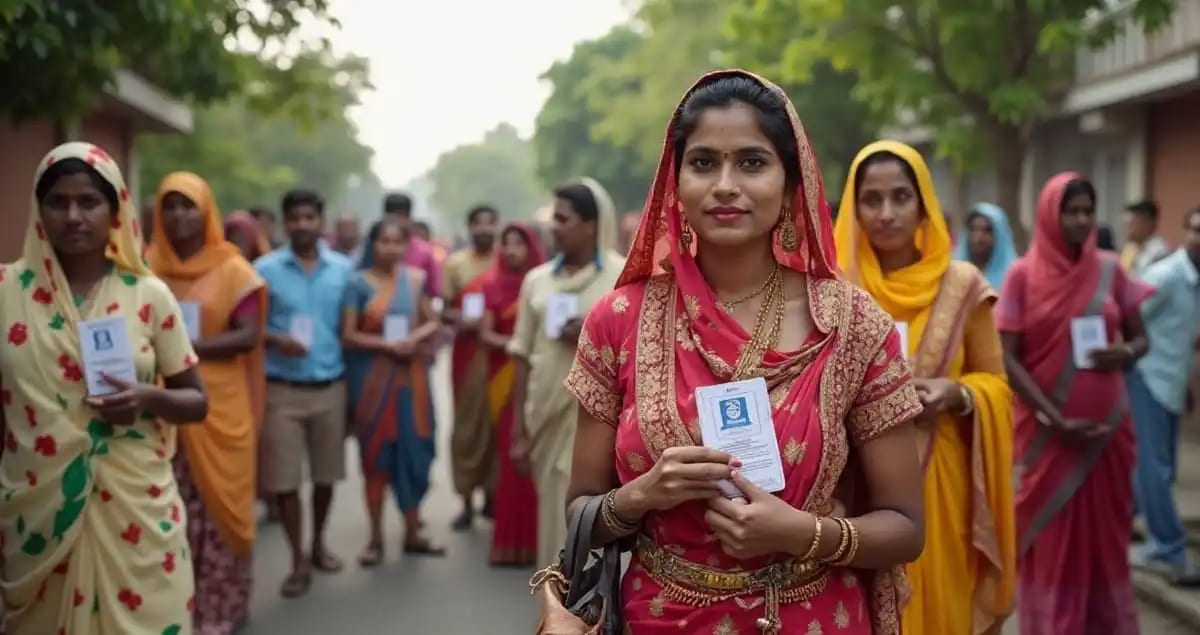
The Unrest Explains India’s Managed Democracy: Global Political Upheavals, Election Hubs, and Strategic AI Governance
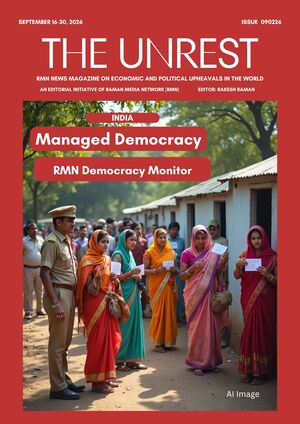
The RMN Democracy Monitor rates India’s democratic framework at 3/10, classifying it as a managed democracy under systemic political and administrative pressures. The September 16–30, 2026 issue of The Unrest magazine examines intensifying state election contests, civic infrastructure failures, global AI policy shifts, and state-linked celebrity influence operations. Published by Raman Media Network, the edition offers independent analysis of political and economic developments in India and beyond.
Raman Media Network The Unrest Desk
New Delhi | September 17, 2026
The RMN Democracy Monitor (RDM), the flagship democracy, elections, and public policy initiative of Raman Media Network, assigns India’s democratic framework an overall score of 3/10. This rating formally classifies the country as a managed democracy shaped by systemic political and administrative pressures.
The September 16–30, 2026 edition of The Unrest magazine documents escalating state-level election battles, severe civic infrastructure failures, shifts in global artificial intelligence policy, and allegations of state-sponsored celebrity propaganda. Produced by RMN News Service, the open-access publication is archived on Zenodo, the European open research platform operated by CERN under the OpenAIRE program, ensuring permanent DOI-based citability.
Indian Politics, Managed Democracy, and Elections
Political analysts note that opposition leader Rahul Gandhi’s efforts to engage Gen Z voters often overlook the operational mechanics of Indian elections. Gandhi has also directly challenged Punjab Chief Minister Bhagwant Mann on administrative accountability following the death of Gulzar Singh.
The ruling Aam Aadmi Party (AAP) faces growing public scrutiny over its governance record ahead of the Punjab Assembly elections. To counter superficial narratives, RMN News maintains the permanent “Punjab Elections | RMN Election Hub” portal for independent electoral investigation.
Separately, the RMN Democracy Monitor has launched a dedicated “Uttar Pradesh Elections” platform covering the February–March 2027 Assembly elections across all 403 constituencies, where 202 seats are required for a governing majority. Commentary in the issue further argues that India’s political system has become deeply compromised, enabling criminal elements and extortionist practices to overshadow public welfare.
AI, Technology, and Digital Policy
Internationally, more than 25 education ministers adopted a joint statement at UNESCO Headquarters in Paris calling for artificial intelligence in education to be regulated as a public common good. In contrast, U.S. President Donald Trump rejected calls from AI executives and experts for a development slowdown, citing national security needs to maintain technological leadership over China.
Within India’s media sector, leading news organizations are forming strategic partnerships with OpenAI to protect news discoverability through direct attribution. While AI tools now handle data processing and routine tasks in newsrooms, journalists remain the primary arbiters of factual reporting.
At the World Telecommunication and ICT Policy Forum 2026 (WTPF-26), representatives from government, industry, and civil society adopted five key Opinions to guide global digital policy. RMN Digital supports corporate decision-makers through its Chief AI Officer (CAIO) Hub and the Technophile newsletter edited by Rakesh Raman.
Crime, Corruption, and Civic Infrastructure
The magazine highlights administrative failures affecting ordinary citizens. India’s passport issuance system has reportedly become an extortive process in which field police officers harass applicants during verification. In Delhi, cooperative group housing societies continue to face systemic corruption across successive regimes; the Free Clean House Service offers a community platform to address local governance shortcomings.
Punjab is simultaneously confronting an escalating power crisis, with daily blackouts lasting 8 to 14 hours. These outages have disrupted agricultural irrigation and industrial output, prompting widespread protests by opposition parties and farmer unions.
Entertainment, Media Governance, and Global Events
In the entertainment sector, the Cine and TV Artistes’ Association (CINTAA) and the Federation of Western India Cine Employees (FWICE) remain locked in a dispute over constitutional authority and union leadership. The publication also criticizes alleged state-backed influence operations, claiming the Modi administration uses coordinated pressure—described as a form of Gleichschaltung—to enlist Bollywood and cricket celebrities in projecting an image of national success.
On the international stage, Donald Trump’s portrait has appeared on a new U.S. $1 coin, marking a notable change in how living American political figures are commemorated on legal tender. Entertainment and media analysis continues through the Movie Mate newsletter powered by RMN Stars.
About The Unrest Magazine
The Unrest is a fortnightly open-access publication from RMN News Service. Each issue curates independent analysis and research-driven perspectives on governance, democracy, human rights, technology, and global affairs. Issues are permanently archived and citable via DOI records on Zenodo to support transparency and scholarly reference.
Rakesh Raman, national award-winning journalist and founder of the RMN Foundation, leads the initiative. A former edit-page technology columnist at The Financial Express and digital media consultant for the United Nations (UNIDO), he specializes in AI governance, digital forensics, and investigative projects on human rights and transparency.
💛 Support Independent Journalism
If you find RMN News useful, please consider supporting us.