


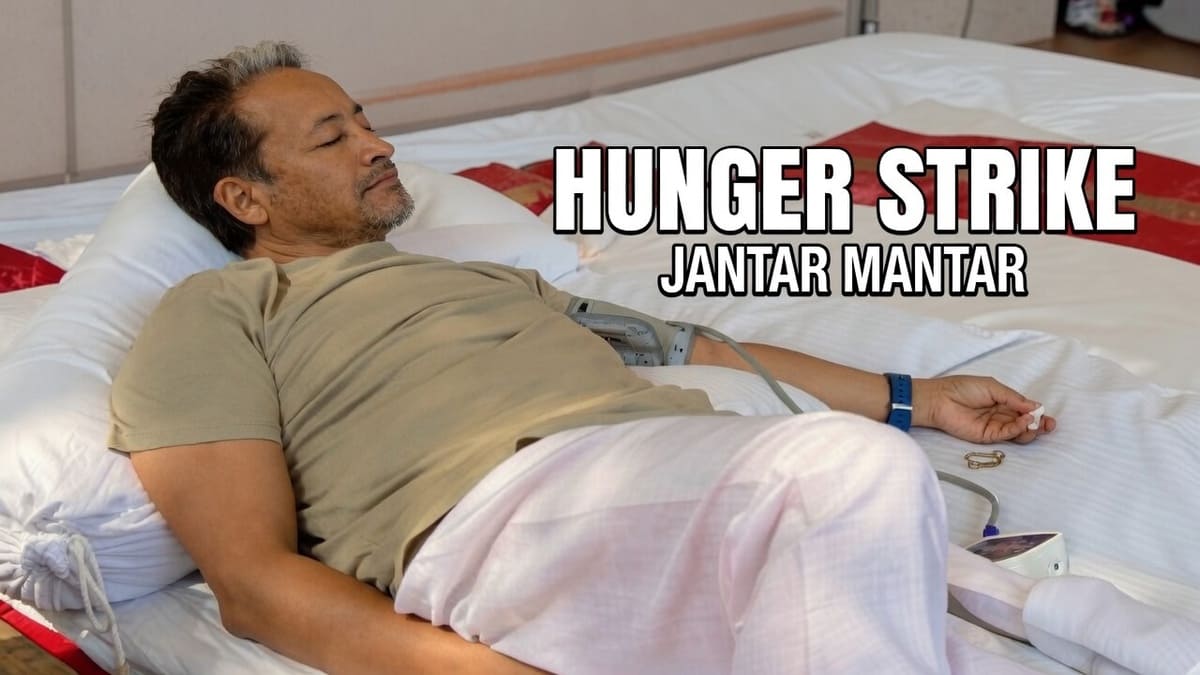
Sonam Wangchuk: The Jantar Mantar Deception Exposed
Sonam Wangchuk and the Cockroach Janta Party (CJP) have failed to translate their digital presence into physical mobilization, leaving the Jantar Mantar protest site nearly deserted. Despite high-profile hunger strikes and failed calls to action regarding student suicides, the movement remains a superficial media exercise. This investigation reveals a “dead” protest that serves more as a performative drama than a legitimate challenge to the current administration.
By Rakesh Raman
New Delhi | July 9, 2026
1. The Digital Mirage: CJP’s Failure of Mobilization
In the performative arena of modern Indian activism, a cavernous strategic gap has opened between social media posturing and ground-level political reality. Digital platforms create a manufactured momentum that evaporates the moment physical presence is required. This disconnect is epitomized by the so-called “Cockroach Janta Party” (CJP), a group whose very name serves as a derisive symptom of its own political insignificance and terminal leadership vacuum.
The CJP is the ultimate “digital mirage of Gen Z politics.” While the party’s leadership boasts of millions of followers online, they have proven utterly incapable of mobilizing a meaningful crowd. In the heart of the national capital, at the legendary Jantar Mantar, a movement claiming massive public resonance could not gather even one hundred warm bodies. The reality on the ground exposes the CJP’s influence as a hollow illusion sustained entirely by manipulated social media metrics.
The CJP is a digital mirage, claiming millions of followers while failing to gather even a hundred people at the heart of India’s capital.
The sparse crowd currently at the site is not composed of aggrieved citizens or the students they claim to represent. Instead, the site is populated by “naive YouTube video makers” chasing a few hundred views with low-quality content and a handful of “curious bystanders” who pause briefly out of habit. This total lack of physical mobilization does not just undermine the CJP’s demands; it renders them a statistical irrelevance in the face of an entrenched administration.
2. The Wangchuk Stratagem: Deception and Hunger Strikes
The “habitual protester” has become a staple of the Indian political theater, utilizing the psychological theater of the hunger strike to hijack public sympathy and media attention. By adopting the persona of a martyr, these figures attempt to bypass concrete political organization in favor of moral grandstanding. Sonam Wangchuk’s transition from Ladakh to Delhi is the latest iteration of this “dirty stratagem.”
[ 🔊 सोनम वांगचुक का जंतर-मंतर आंदोलन: ऑडियो विश्लेषण ]
Wangchuk’s recent efforts are built on a series of failed calls to action. His July 8th message regarding 20 student suicides and his July 20th “Peaceful March to Parliament” were designed to manufacture a national crisis, yet the authenticity of his “indefinite hunger strike” remains unconfirmed and largely unobservable. Observers increasingly frame this as a desperate pursuit of “cheap publicity” following the total failure of his routine protests in Ladakh to extract even a minor concession from the Modi regime.
The stratagem is further exposed by a glaring intellectual paradox: while Wangchuk demands the resignation of Education Minister Dharmendra Pradhan, he simultaneously offers public praise for the regime’s education policy. This absurdity—demanding a minister’s ouster while validating his primary work product—highlights a movement that is more interested in the “drama” of protest than the substance of reform. This personal failure of strategy mirrors the broader impotence of peaceful resistance in the current political climate.
3. The Failure of Peaceful Protest in Autocratic Frameworks
History teaches that the efficacy of a protest model is determined by the nature of the regime it confronts. While passive resistance may influence a functioning democracy, it is a catastrophic “blunder” within an autocratic framework where justice systems have collapsed. In environments where rulers are hell-bent on destroying democratic structures, traditional “candle marches” and “hunger strikes” are not merely ineffective; they are ignored.
Peaceful marches and hunger strikes are failing in an era where only radical models of public demonstration seem to achieve political results.
Wangchuk’s “passive protest” wilts when compared to the “Bangladeshi, Nepali, and Sri Lankan models,” where radical public demonstrations successfully toppled regimes in mere days. While peaceful protests are brutally suppressed in nations like Russia, Belarus, China, Hong Kong, Myanmar, and Thailand, the Indian experience under the current administration provides a grim catalog of failed non-violent movements:
- The CAA Protests: High-profile dissent that resulted in zero policy shifts.
- The Farmers’ Protest: A year-long mobilization that failed to secure core demands like MSP.
- The Women Wrestlers’ Protest: A peaceful campaign that was systematically neutralized.
- EVM Protests: Demonstrations against electoral integrity that failed to trigger systemic change.
While the “Storming of the Bastille” during the French Revolution serves as a historical reminder of how radical action can collapse a monarchy’s abuse of power, the performance at Jantar Mantar is a toothless facsimile. It is a stage play being performed for an audience that has already left the theater.
4. Political Complicity and the Ineffective Opposition
The survival of this “dead” protest is managed through the complicity of mainstream political entities. Established parties often surreptitiously supply “hired crowds” to maintain a facade of opposition, allowing them to project resistance without the risk of direct street confrontation. This controlled dissent ensures the “drama” continues while the status quo remains untouched.
Central to this ineffective politics is Rahul Gandhi, often characterized as the “Barking Dog of Indian Politics.” Gandhi remains a largely “digital” entity, seemingly scared to mobilize Congress workers for actual street combat, preferring instead to issue random statements on social media. This reticence has allowed the regime to capture democratic institutions at will. Furthermore, the protest’s target—Minister Dharmendra Pradhan—is a mere “pawn” and a beneficiary of election manipulations led by the central leadership. Wangchuk’s focus on a non-entity like Pradhan is a deliberate misdirection intended to avoid the ruthless reprisal that would follow any direct challenge to the Prime Minister.
The movement is further diluted by “tainted politicians” and “selfish farmers.” These farmer groups, having zero experience in leading successful campaigns, previously abandoned their own causes to pursue failed electoral bids in Punjab. Their involvement provides rhetorical noise but lacks the grit or commitment required for a genuine political uprising.
5. Conclusion: The Implosion of a Non-Existent Campaign
The situation at Jantar Mantar has reached a state of total collapse. Sonam Wangchuk is effectively “deceiving” his remaining followers with a campaign that exists as a media phantom rather than a physical reality. The most damning evidence of the protest’s insignificance is the behavior of the Delhi Police. Typically a “ruthless force,” the police haven’t even bothered to remove Wangchuk—his protest is so “almost dead” that it no longer warrants the effort of suppression.
As the stratagem fails to gain traction, the predicted endgame is a face-saving exit. Wangchuk is expected to eventually manufacture a medical emergency, leading to a hospital transfer where he can end his strike without admitting defeat. This performative drama, sustained only by the occasional “hired crowd” provided by a cowardly opposition, is the final gasp of a movement that never truly began. Without a shift toward radical mobilization, the Jantar Mantar protest will be remembered only as a digital mirage that vanished in the light of day.
By Rakesh Raman, who is a national award-winning journalist and social activist. He is the founder of a humanitarian organization RMN Foundation which is working in diverse areas to help the disadvantaged and distressed people in the society.
💛 Support Independent Journalism
If you find RMN News useful, please consider supporting us.