
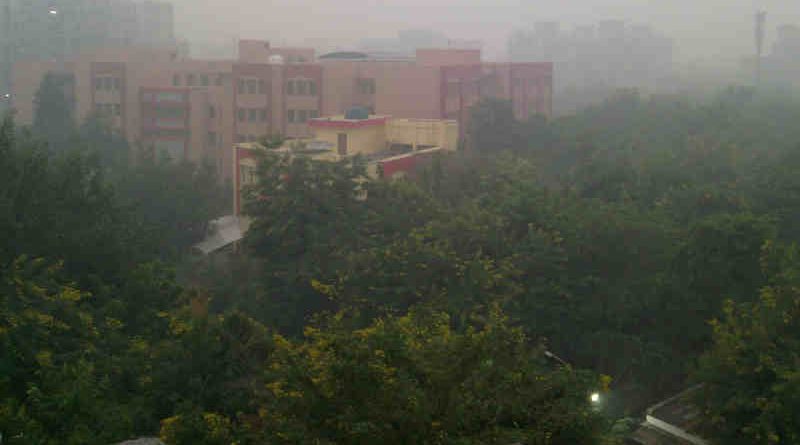
New AI Initiative Targets Pollution Accountability Amid Delhi-NCR’s Severe Smog Crisis
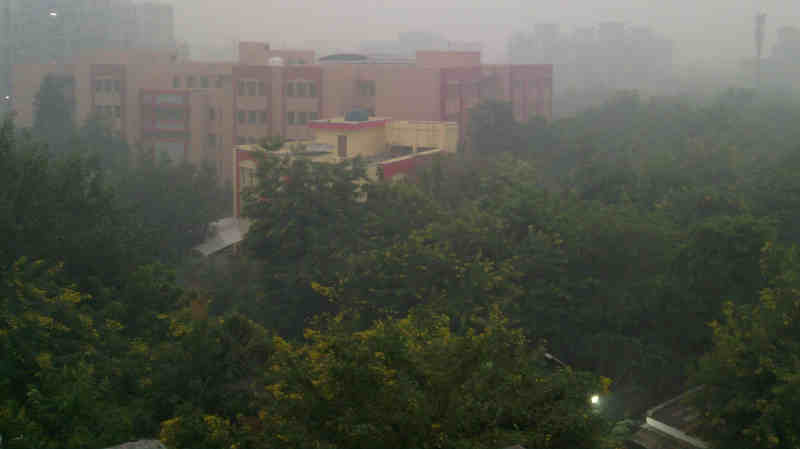
New AI Initiative Targets Pollution Accountability Amid Delhi-NCR’s Severe Smog Crisis
Aether 360 is designed to challenge governmental inaction and denial by delivering concrete, location-specific evidence of pollution’s causal role in health crises.
By RMN News Service
New Delhi | December 7, 2025
In the midst of an escalating air pollution disaster in India’s Delhi-National Capital Region (NCR), a groundbreaking artificial intelligence project has been unveiled to hold authorities accountable for the health impacts of toxic air. November 2025 marked one of the worst pollution periods in recent memory, with the entire top 10 list of India’s most polluted cities falling within the Delhi-NCR area.
Ghaziabad emerged as the most affected, posting an average PM2.5 concentration of 224 micrograms per cubic meter—over triple the country’s safety threshold. The city endured 19 days classified as “very poor” air quality and 10 “severe” days, with no single day meeting national standards. Delhi itself placed fourth on the list, with PM2.5 levels averaging 215 micrograms per cubic meter, a sharp doubling from the previous month.
Analysts from the Centre for Research on Energy and Clean Air (CREA) pointed out that while crop residue burning contributed less this year—averaging just 7% compared to 20% last year—pollution intensified in 20 of the 29 NCR cities. This surge underscores persistent issues from ongoing sources like vehicles, factories, power generation, and other burning activities, highlighting the urgent need for targeted reductions in emissions across these sectors.
Against this backdrop, journalist and advocate Rakesh Raman has introduced Aether 360, a self-financed proof-of-concept initiative aimed at exposing the direct links between air pollution and public health emergencies. The project seeks to develop the first-ever AI system to compute an “Attribution Rate” (A-Rate), which measures the precise likelihood that a patient’s hospital visit for respiratory or heart issues stems directly from recent pollution surges. Utilizing Explainable AI (XAI), it will establish a “Pollution Probability Link” (PPL) by analyzing detailed air quality data alongside anonymized medical records.
Aether 360 is designed to challenge governmental inaction and denial by delivering concrete, location-specific evidence of pollution’s causal role in health crises. By tallying the number of hospital admissions attributable to poor air quality, the initiative hopes to drive sweeping policy reforms. To achieve full validation, the project calls for collaborations with global bodies like the World Health Organization (WHO), the United Nations Environment Programme (UNEP), or institutions such as the All India Institute of Medical Sciences (AIIMS), using de-identified patient information.
This innovative approach likens air pollution to an unseen attacker, with Aether 360 serving as an advanced investigative tool to connect environmental data with real human suffering, ultimately pushing for stronger interventions to protect public health. As winter smog tightens its grip on Delhi-NCR, such efforts underscore the critical intersection of technology, activism, and environmental justice.
💛 Support Independent Journalism
If you find RMN News useful, please consider supporting us.