India Classified an “Electoral Autocracy” Amid Widespread EVM Manipulation Allegations
India Classified an “Electoral Autocracy” Amid Widespread EVM Manipulation Allegations
With domestic oversight viewed as increasingly futile due to institutional capture, civil society groups are calling for the United Nations and the Inter-Parliamentary Union (IPU) to supervise future Indian elections.
By Rakesh Raman
New Delhi | April 2, 2026
NEW DELHI — International watchdogs and investigative reports are raising urgent alarms over what is described as a systemic dismantling of democratic institutions and high-tech manipulation of the electoral process in India.
The “Smoking Gun”: Technical Impossibilities
The credibility of India’s Electronic Voting Machine (EVM) system is under intense scrutiny following the discovery of “impossible” voting speeds during the 2024 elections. While EVMs require a minimum of 14 seconds to reset between each vote, investigative findings from specific booths revealed a “fraudulent peak” of one vote every six seconds. This discrepancy – reported on April 2, 2026 – suggests that votes were being logged without the presence of actual voters.
Further anomalies include a “Midnight Surge” phenomenon identified in the Andhra Pradesh elections. Data synthesized by economist Parakala Prabhakar reveals that nearly 52 lakh votes were cast during the late-night window between 8 pm and 2 am—a pattern that defies conventional voter behavior and suggests a clandestine entry of ballots. Additionally, initial reported turnout figures were revised upward by massive margins days after polling ended.
Transparency Deficit and Institutional Capture
The Modi regime has been accused of transitioning India into a “dark democracy” by suppressing critical booth-level records. Senior advocates and former Chief Election Commissioners have sounded the alarm over the Election Commission of India’s (ECI) refusal to make Form 17C (booth-level counts) and Form 20 (final result sheets) public. Senior advocate Prashant Bhushan warned that “democracy can’t run in the dark,” noting that the lack of transparency prevents independent audits of aggregated totals.
[ India’s 2026 Economic Pulse: A Socio-Economic Overview of Interconnected Crises ]
Furthermore, the ECI has been criticized for releasing voter lists in non-machine-readable formats, strategically crippling the ability of opposition parties to identify fraudulent entries. Allegations of a mismatch between EVM electronic records and physical VVPAT slips persist, yet the ECI and the Supreme Court have frequently dismissed complaints without conducting public technical audits.
International Downgrade to “Electoral Autocracy”
The V-Dem Institute, in its 2026 Democracy Report, has officially reclassified India as an “electoral autocracy”. India is now grouped with China, Indonesia, and Pakistan as one of the world’s most populous autocracies. Analysts suggest the regime may be following a “North Korean model,” allowing minor opposition wins to maintain a facade of competition while holding an absolute grip on national power.
Narrative Management and “Smokescreens”
To mask electoral irregularities and socio-economic distress, the regime is accused of using a national security “smokescreen,” frequently utilizing rhetoric regarding terrorism to divert public attention.
Investigative reports also highlight a chilling collusion between the state and Bollywood. Films are reportedly used to build a cult of personality or serve as cinematic cloaks for military and policy failures. Most critically, reports expose “systemic box office data laundering,” where fraudulent financial records are used to manufacture an illusion of overwhelming public support that stands in stark contrast to the lived reality of poverty and inflation.
Demands for International Intervention
With domestic oversight viewed as increasingly futile due to institutional capture, civil society groups are calling for the United Nations and the Inter-Parliamentary Union (IPU) to supervise future Indian elections. Experts are demanding three non-negotiable reforms:
- Mandatory 100% counting and verification of VVPAT slips.
- Same-day disclosure of real-time polling percentages.
- Immediate public release of booth-level summaries and Form 20 sheets.
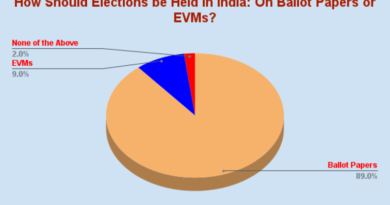
Without a move back to paper-based voting or a fully transparent, audited system, experts warn that the integrity of the world’s largest democracy remains in terminal decline.
The EVM microsite is publicly accessible at: https://rmnsite.my.canva.site/evm-website-rmn
By Rakesh Raman, who is a national award-winning journalist and social activist. He is the founder of a humanitarian organization RMN Foundation which is working in diverse areas to help the disadvantaged and distressed people in the society.
💛 Support Independent Journalism
If you find RMN News useful, please consider supporting us.