Understanding the Arguments Against EVMs in India
Understanding the Arguments Against EVMs in India
The Raman Media Network advocates for international engagement as a direct result of the perceived “erosion of domestic oversight” by Indian constitutional bodies like the ECI and the Supreme Court.
By Rakesh Raman
New Delhi | January 28, 2026
This document summarizes the main arguments and evidence against the current use of Electronic Voting Machines (EVMs) in India, as documented by the Raman Media Network (RMN) and RMN Foundation. Their dedicated microsite, titled “EVMs in Indian Elections: Threat to Democracy,” is an editorial initiative that has been compiling research, public complaints, and international perspectives on this critical issue for nearly five years, offering a comprehensive critique of the system’s integrity.
1. The Core Accusation: Is the System Tilted?
The central claim detailed by the Raman Media Network is that India’s electoral system may be compromised. Numerous complaints filed by opposition political parties and concerned citizens allege that the Bharatiya Janata Party (BJP), led by Prime Minister Narendra Modi, has unfairly benefited from the selective manipulation of EVMs in key state and national elections. This accusation forms the basis for a profound concern about the erosion of electoral integrity and democratic norms in the country.
This accusation is not made in a vacuum; it is supported by a multi-pronged critique targeting the voting technology itself, the institutions meant to safeguard it, and the political response to alleged irregularities.
2. Four Pillars of the Argument Against EVM Integrity
The case against EVMs, as presented in the RMN initiative, rests on several key pillars of evidence, analysis, and institutional critique.
2.1 The VVPAT Paradox: Seeing Isn’t Always Believing
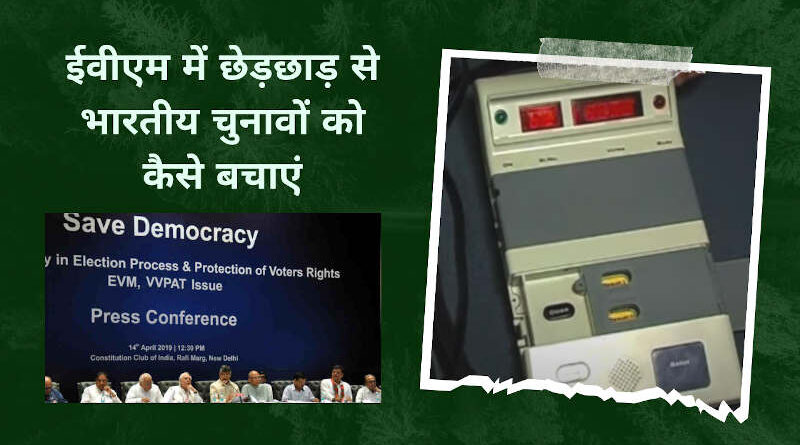
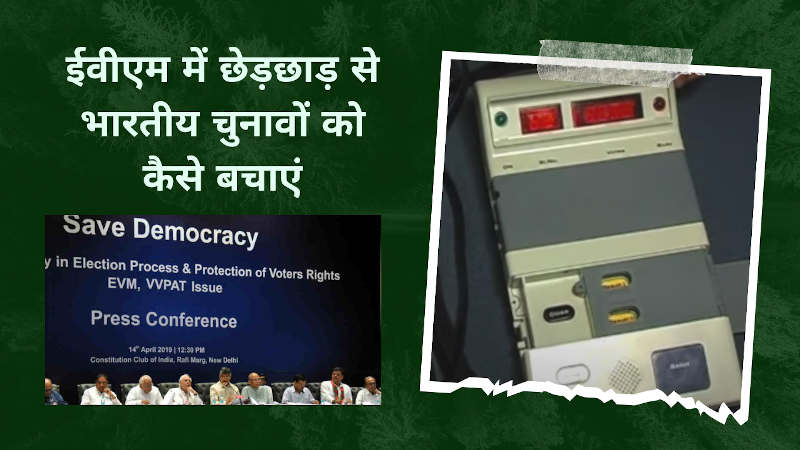
A core issue highlighted involves the Voter Verifiable Paper Audit Trail (VVPAT) system, which was introduced to increase transparency by printing a paper slip for voter confirmation. However, the central allegation is that the paper slip a voter sees may not always correspond to the vote that is electronically recorded in the machine’s control unit. This creates a paradox: the very system designed to build trust through physical verification could, in theory, act as a “smokescreen,” providing a false sense of security while the unverified electronic vote is the one that ultimately counts.
2.2 Institutional Inaction: Who is Listening?
A significant part of the argument focuses on the alleged failure of India’s constitutional bodies to address persistent complaints. The RMN microsite contrasts the official narrative with the reality of ignored grievances.
| Official Stance of the Election Commission (ECI) | RMN Microsite’s Counter-Argument |
| The ECI has long asserted that while EVMs are machines that can malfunction, they are fundamentally secure and cannot be tampered with to alter election results. | The microsite critiques this stance, arguing that the ECI and the Supreme Court have allegedly ignored or dismissed numerous complaints without conducting substantive investigations. It further notes that the ECI’s security claims lack the backing of public technical audits or transparent verification processes. |
2.3 Documented Irregularities: A Pattern of Problems
The RMN initiative serves as a repository for various forms of evidence that suggest a pattern of systemic issues. This documentation is multi-faceted and includes:
Reports from Citizen Groups: It cites a detailed report by the Citizens’ Commission on Elections, which meticulously documents multiple abnormalities and operational issues involving both EVMs and VVPATs.
Electoral Data and Media Analysis: The platform curates news reports and analytical articles that highlight significant voting discrepancies, abnormal voter turnout patterns, and counting anomalies reported in several recent elections.
Public and Political Discourse: Evidence is compiled from parliamentary statements, documentation of citizen-led street protests, and the results of an RMN public poll on the credibility of EVMs.
Theoretical Vulnerability Analysis: It uses AI-based analysis tools, including ChatGPT, to outline potential security flaws and theoretical vulnerabilities in EVM-based election systems.
Broader Contextual Research: It references The Smokescreen 2026 research report to frame the EVM issue within a larger context of electoral opacity and the alleged capture of democratic institutions in India.
2.4 Ineffective Resistance: A Fractured Opposition
The microsite also offers a critical assessment of the response from political challengers. It characterizes the campaigns by opposition parties, particularly the Congress, as “futile and inconsistent.” The argument is that these parties have failed to mount the kind of sustained legal or street-level resistance that would be necessary to force institutional accountability and reform.
Having identified these deep-seated problems, the Raman Media Network initiative shifts its focus to a proposed solution that looks beyond India’s borders.
3. The Proposed Solution: A Call for International Eyes
The Raman Media Network advocates for international engagement as a direct result of the perceived “erosion of domestic oversight” by Indian constitutional bodies like the ECI and the Supreme Court. It argues that when internal mechanisms for accountability fail, external supervision becomes necessary to preserve democratic principles.
To underscore the gravity of the situation, the platform incorporates a warning from former UN Secretary-General Kofi A. Annan, who stated that compromised elections undermine the very foundation of democratic legitimacy. Based on this premise, the RMN initiative proposes a specific form of international intervention: supervision of future Indian elections by the UN–Inter-Parliamentary Union (IPU), with the IPU headquartered in Switzerland.
This call for external oversight represents a conclusion that domestic avenues for redress have been exhausted.
4. Summary of Key Takeaways for the Learner
For a clear understanding of the arguments presented by the Raman Media Network, here are the three essential takeaways:
Fundamental Distrust: The core argument is a significant trust deficit in the voting system. The central allegation is that the VVPAT paper trail, meant to ensure transparency, may not actually match the electronic vote recorded by the machine, undermining the entire system’s integrity.
Institutional Failure: A major grievance is the alleged failure of the Election Commission of India and the Supreme Court to meaningfully investigate the large volume of complaints filed by political parties, citizen groups, and activists regarding EVM and VVPAT irregularities.
A Call for Outside Help: Due to the perceived lack of effective and impartial domestic oversight, the RMN initiative concludes that international supervision is necessary. It specifically calls for organizations like the United Nations (UN) and the Inter-Parliamentary Union (IPU) to oversee future elections to safeguard their fairness.
The EVM microsite is publicly accessible at: https://rmnsite.my.canva.site/evm-website-rmn
By Rakesh Raman, who is a national award-winning journalist and social activist. He is the founder of a humanitarian organization RMN Foundation which is working in diverse areas to help the disadvantaged and distressed people in the society.
💛 Support Independent Journalism
If you find RMN News useful, please consider supporting us.