
Investigation Uncovers Deep-Rooted Corruption and Lack of Transparency in Delhi Housing Societies
Investigation Uncovers Deep-Rooted Corruption and Lack of Transparency in Delhi Housing Societies
The report asserts that this lack of transparency is a “calculated strategy” supported by a corrupt alliance between MCs and various government departments. Investigation findings suggest that MCs operate “hand in glove” with officials from the RCS, the Delhi Development Authority (DDA), and the Delhi Police.
By Rakesh Raman
New Delhi | January 10, 2026
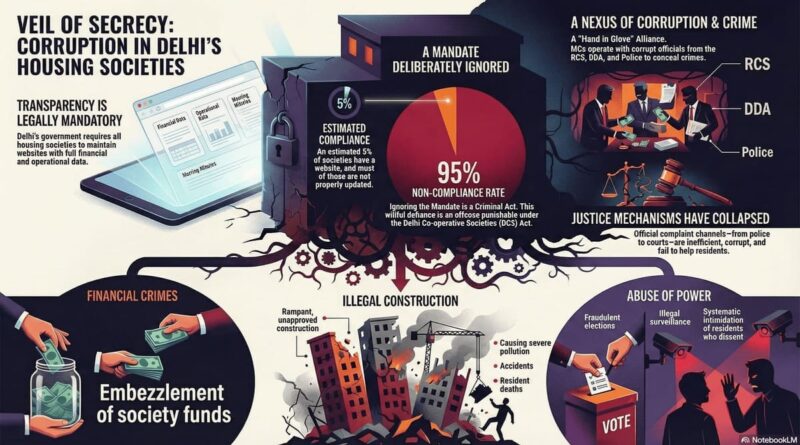
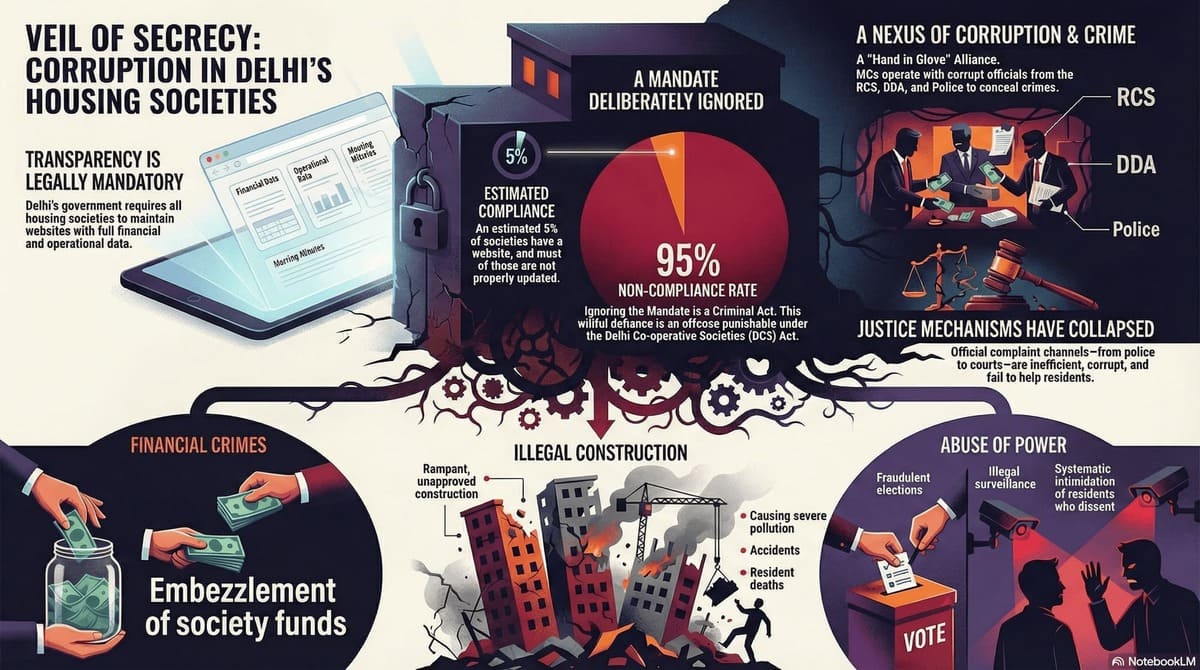
An investigative report by RMN News Service reveals that the ideal of cooperative living in Delhi has been replaced by a systemic environment of crime, corruption, and harassment. The report highlights that many Management Committees (MCs) of housing societies are operating under a “veil of secrecy,” deliberately avoiding mandatory transparency measures to facilitate illicit activities.
The Mandate for Transparency Ignored
Since at least 2015, the Office of the Registrar Cooperative Societies (RCS) has issued legally binding directives requiring all Delhi housing societies to maintain regularly updated, transparent websites. These websites are intended to serve as a low-cost tool for resident accountability. These online platforms must include:
- Financial transaction records, including vouchers and purchase documents.
- Details of all society members and specific criteria for vendor appointments.
- Records of all internal and external communications and the status of legal cases.
- An online form for residents to register complaints.
Despite these clear directives and the availability of free software to build such sites, an estimated 95% of housing societies have failed to comply. This non-compliance is legally categorized as a criminal offense under the Delhi Co-operative Societies (DCS) Act and the Bharatiya Nyaya Sanhita.
[ 🔊 दिल्ली की हाउसिंग सोसायटियों में व्याप्त भ्रष्टाचार: ऑडियो विश्लेषण ]
A Nexus of Corruption
The report asserts that this lack of transparency is a “calculated strategy” supported by a corrupt alliance between MCs and various government departments. Investigation findings suggest that MCs operate “hand in glove” with officials from the RCS, the Delhi Development Authority (DDA), and the Delhi Police.
Specific allegations of complicity include:
- RCS Office: Allegedly accepting bribes to ignore non-compliance and close inquiry cases without action.
- DDA & MCD: Implicated in supporting unauthorized Floor Area Ratio (FAR) construction.
- Delhi Police: Accused of failing to include culpable MC members in FIRs, even in cases involving accidental deaths linked to illegal construction.
Impact on Residents
The lack of oversight has led to rampant financial crimes, such as embezzlement, extortion, and the illicit sale of parking spaces. Furthermore, residents are subjected to the hazards of unauthorized construction projects, which create severe noise and dust pollution. Those who dissent often face intimidation, illegal surveillance, and human rights violations.
The Collapse of Accountability
Existing grievance mechanisms, such as the Public Grievance Monitoring System (PGMS) and perfunctory RCS inquiries, have largely failed because they are often managed by the same officials implicated in the corruption. In response, the “Clean House” editorial service has emerged as a journalistic mechanism to exert institutional pressure and provide a platform for residents to report civic neglect and financial swindling.
Proposed Radical Reforms
The investigation concludes that Delhi’s housing crisis requires immediate intervention, including:
- Prosecution of non-compliant MC members under criminal codes.
- A total revamp of the RCS office, including a direct portal for complaints against corrupt officials.
- The establishment of a separate jail specifically for corrupt MC members and complicit bureaucrats.
- International intervention from human rights agencies due to the failure of local judicial forums.
Think of a housing society’s mandatory website as a “glass vault.” While a traditional vault keeps valuables safe but hidden, a glass vault allows every member to see exactly what is inside and how the contents are being handled. By refusing to build this “glass vault,” Management Committees are essentially keeping the community’s assets in a black box, allowing them to move funds and make decisions in total darkness where no one can see them.
By Rakesh Raman, who is a national award-winning journalist and social activist. He is the founder of a humanitarian organization RMN Foundation which is working in diverse areas to help the disadvantaged and distressed people in the society.
💛 Support Independent Journalism
If you find RMN News useful, please consider supporting us.